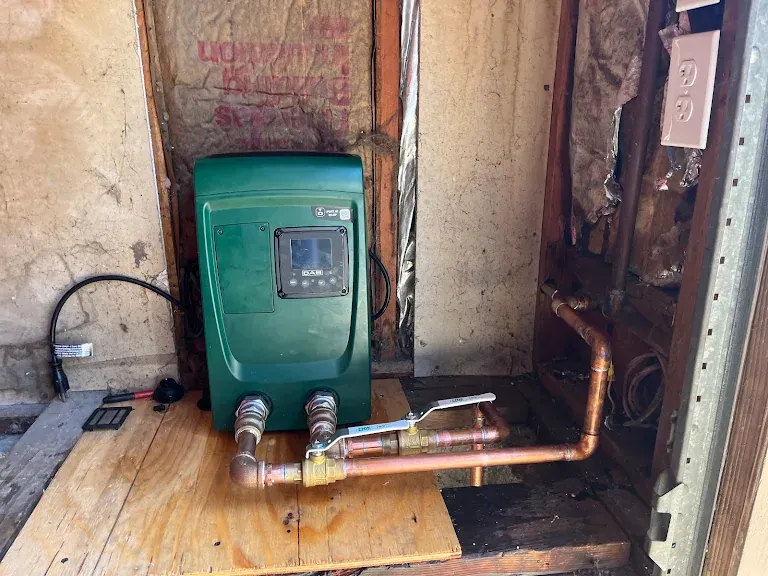
A booster pump fixes that. It takes whatever pressure arrives at the house and raises it to a steady, chosen number, with a variable-speed motor that ramps up when three fixtures run and idles when one does. We install DAB constant-pressure boosters most often because they are quiet, compact, and they hold pressure without the surging that older pump-and-tank setups are known for.
Before we sell you a pump, we make sure a pump is the answer. A fair share of low-pressure calls turn out to be a failed pressure reducing valve, a half-closed shutoff, or galvanized pipe rusted down to a straw. Those are cheaper fixes and we will tell you so. The estimate is free and the price is flat.
Why pressure drops between the meter and your shower
Water loses pressure two ways on its trip to the tap. Every foot of elevation costs a little under half a psi, so a house sitting a hundred feet above the main in the road has given up more than forty psi before the water even reaches the foundation. Steep lots around Manchester, Southworth, Fox Island and the Hood Canal shoreline see this constantly. The utility is not wrong; physics is just unforgiving.
The second thief is friction. A long service line, an undersized one, or an old galvanized line with its inside walls closed up with rust scale all throw away pressure in proportion to how much water is moving. That is why these homes feel fine when one faucet runs and fall apart when the washer, the shower and the sprinkler run together. Static pressure looks acceptable on a gauge; working pressure is what you live with.
Then there are supply-side limits. Small community water systems in Mason County and on the Key Peninsula, older neighborhoods at the end of a utility's distribution grid, and shared wells with a tank sized for fewer homes than are now on it all deliver less than a modern household expects.
What a constant-pressure booster does
A modern booster is a pump, a small pressure vessel, a flow sensor and a variable-frequency drive in one housing about the size of a carry-on bag. You set a target pressure, and the drive spins the motor just fast enough to hold it. Open one faucet and it barely hums. Open four and it works harder, but the pressure at every fixture stays where you set it. Close everything and it shuts off and waits.
This is different from the booster-and-big-tank systems of twenty years ago, which cycled on and off between a low and a high setting the same way a well pressure tank does. Those work, but they surge, and the tank takes up a corner of the garage. The DAB e.sybox and similar units replace all of that with one box that also shuts itself down on dry-run so it will not cook itself if the supply fails.
A booster needs a few things to be happy: an inlet pressure above zero (it boosts, it does not suck water uphill from a dry pipe), a 120-volt circuit nearby, and a spot that stays above freezing. We check all three before quoting.
Booster pumps on wells and community systems
On a private well, the pressure tank and switch already do the job of a booster for most homes. Where a booster earns its place is a well home with a long uphill run from the pump house to the house, a second residence or ADU above the main house, or an irrigation demand the well cannot keep up with by itself. We plumb it after the pressure tank and set its target above the well switch's cut-out so the two do not fight each other.
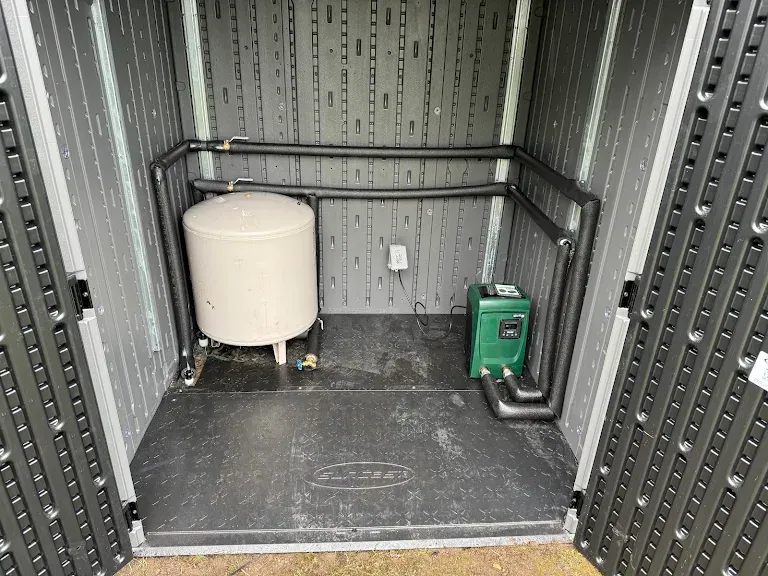
Community and shared water systems are a different story. A tank on the hill serving a dozen homes delivers gravity pressure that falls off for the houses highest on the hill, and those owners get a trickle while the lowest home has plenty. A booster at the house with a small holding tank ahead of it, like the shed installation we did for a home on a weak community system, gives that house its own steady pressure without affecting the neighbors. Most systems allow a booster on the house side of the meter; a few ask for an atmospheric tank first, and we know which is which.
Utility customers should check one thing: many water districts around Kitsap and Pierce will tell you the pressure in the main at your meter. If it is low there, a booster is the fix. If it is healthy there and weak inside, the problem is in your pipe, and we go find it.
Where the pump goes and how it is plumbed
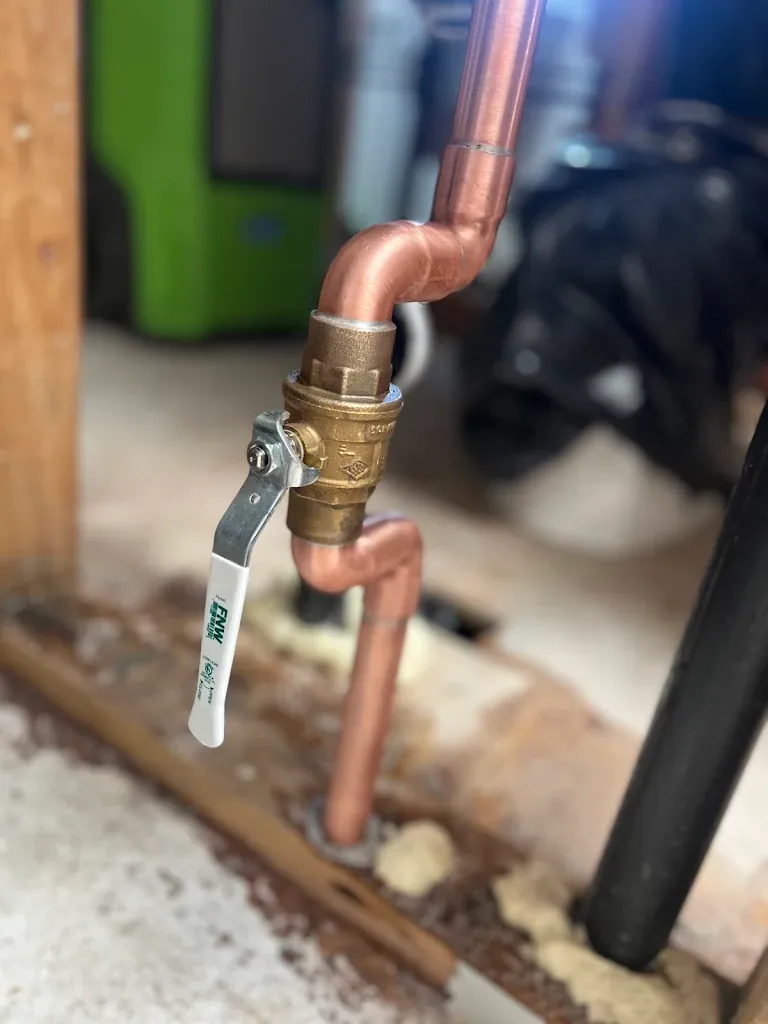
The booster goes on the main line after the shutoff and before the first branch, so every fixture in the house benefits. In most homes that is the garage, the utility room, a crawlspace with headroom, or an insulated pump house. It mounts on rubber feet or a small pad to keep the hum out of the framing. We plumb it in copper or PEX with full-port ball valves on both sides and a bypass loop, so the house can run on street pressure if the pump is ever serviced.
A check valve ahead of the pump keeps boosted water from pushing back toward the meter. An expansion tank goes in or gets checked, because boosted pressure plus a water heater is exactly the combination that makes a relief valve drip. If the home has a pressure reducing valve from the days when pressure was high, it comes out or gets reset; a PRV fighting a booster is wasted money in both directions.
Target pressure is set with a gauge at the farthest fixture, not at the pump. We aim for a comfortable number at the second-floor shower rather than a dramatic one at the hose bib, because too much pressure wears out fixtures and supply lines just as surely as too little annoys you.
When a booster is not the right fix
We turn down booster jobs when the pipe is the problem. Boosting pressure through a rusted galvanized line just finds the next weakest spot and makes it leak. If a camera, a gauge test or a cut section shows closed-up galvanized, the honest recommendation is a repipe or a new service line, and the pressure comes back on its own. The same goes for a service line that is undersized for the house; a booster can help, but a properly sized line fixes it for good.
A single weak fixture is never a booster problem. A shower that has lost pressure while the sink next to it is fine has a clogged cartridge, a scaled showerhead or a kinked supply. A whole floor that is weak while the floor below is fine may just be a half-closed valve someone touched during a remodel. We check the cheap things first, and we tell you what we found whether or not it leads to a sale.
Signs you need water pressure booster pumps
Call if you notice
- The shower slows to a drizzle when the washing machine fills
- Your house sits well above the road or at the top of a long driveway
- Pressure is fine downstairs and poor upstairs or in an ADU
- The utility says pressure at the meter is normal but it is weak inside
- A community water system or shared well leaves the uphill homes short
- A long gravel-driveway service line feeds the house
- Sprinklers cannot run while anyone is in the shower
- A tankless water heater drops out because flow is too low to fire it
How a water pressure booster pumps call goes
Pressure test, not a guess
We put a gauge on a hose bib and on the farthest fixture, run several fixtures at once, and watch what happens. Static and working pressure tell us whether the problem is supply, elevation or pipe.
Rule out the cheap causes
Shutoff valves, a failed pressure reducing valve, a clogged filter and rusted galvanized pipe are checked before anyone talks about a pump. If one of those is the answer, that is the quote you get.
Size and place the pump
We pick a booster for the home's fixture count and the lift it has to overcome, then choose a location with power, drainage and freeze protection. The flat price goes to your phone.
Install with valves and a bypass
Copper or PEX, full-port isolation valves, a check valve, a bypass loop, and an expansion tank where the water heater calls for it. Any old PRV is removed or reset.
Dial it in at the far fixture
Target pressure is set by gauge at the fixture that matters most, run under load, and checked for noise and cycling. You get a walkthrough of the display and the bypass.
Questions we get about water pressure booster pumps
How much pressure can a booster pump add?
Residential constant-pressure units can add several tens of psi above whatever arrives at the house. We set the target to a comfortable number at the farthest fixture rather than the maximum the pump can make, because high pressure shortens the life of everything downstream.
Will a booster pump work if I am on a well?
Yes, plumbed after the pressure tank. It makes sense on a well when the house sits far uphill from the pump house or when an ADU or irrigation outruns the well. For most single-home wells, correcting the tank and switch settings is the better first step and we will tell you if that is the case.
Is a booster pump loud?
The variable-speed units we install are quiet enough to sit in a utility room without being noticed. Older fixed-speed pumps with a big tank are the ones people remember as noisy. Mounting on rubber feet keeps the hum out of the framing.
Do I need a holding tank with a booster?
Usually not on a utility supply. Some community water systems require an atmospheric break tank ahead of a booster, and in that case we install a small tank with a float valve and the pump draws from it. We check the system's rules before quoting.
Can a booster pump fix low pressure caused by old pipes?
It can mask it, and we will not do that. Boosting pressure into rusted galvanized pipe tends to find the next leak. If the pipe is the problem, the right fix is a repipe or a new service line, and the pressure comes back without a pump.
What happens if the pump fails?
The bypass loop we install lets you open two valves and run the house on street pressure until it is serviced. The pump also protects itself by shutting down if the supply runs dry.
Will a booster pump help my tankless water heater?
Often. Tankless heaters need a minimum flow to fire, and low pressure can drop below it when a second fixture opens. Steady boosted pressure keeps the flow up. We check the heater's requirements when we size the pump.
Does the pump need its own electrical circuit?
A dedicated 120-volt outlet near the pump location is ideal. If one is not there, we coordinate with an electrician; we do not do electrical work ourselves.