
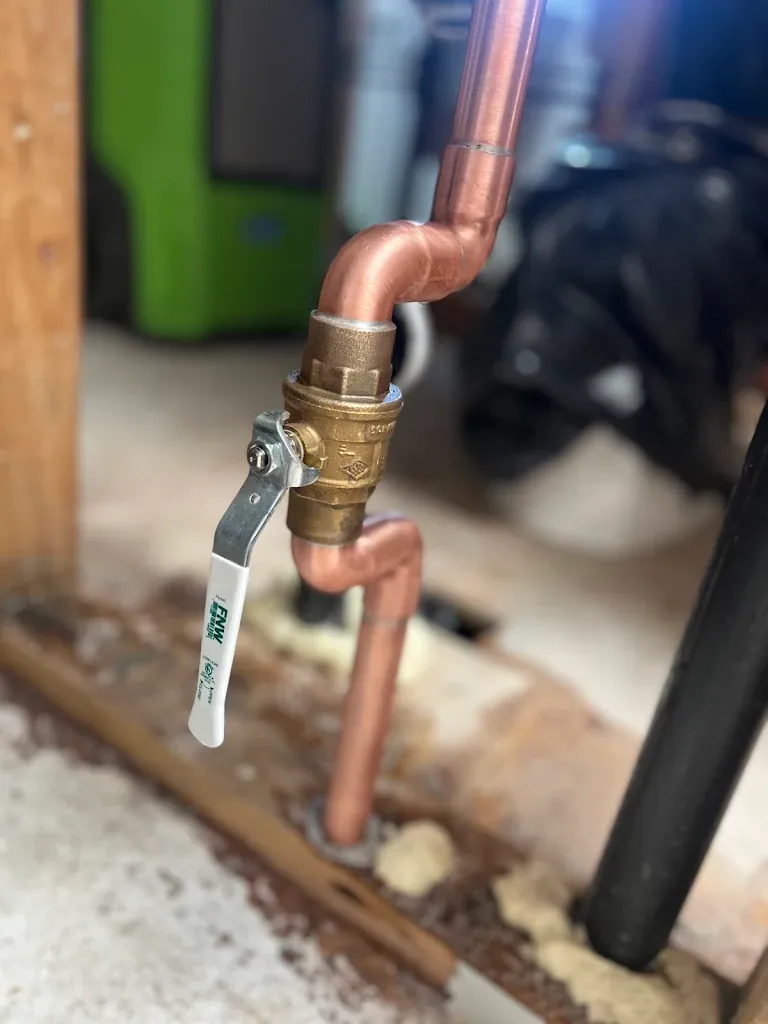
Washington Plumbing & Drain replaces main water shutoff valves across Kitsap, Pierce and Mason counties, in crawlspaces, garages, utility closets, exterior walls and meter boxes. We install full-port brass ball valves, add a drain so the house can be winterized, and, when the existing valve is somewhere a homeowner cannot reasonably get to, we relocate it to a place that makes sense.
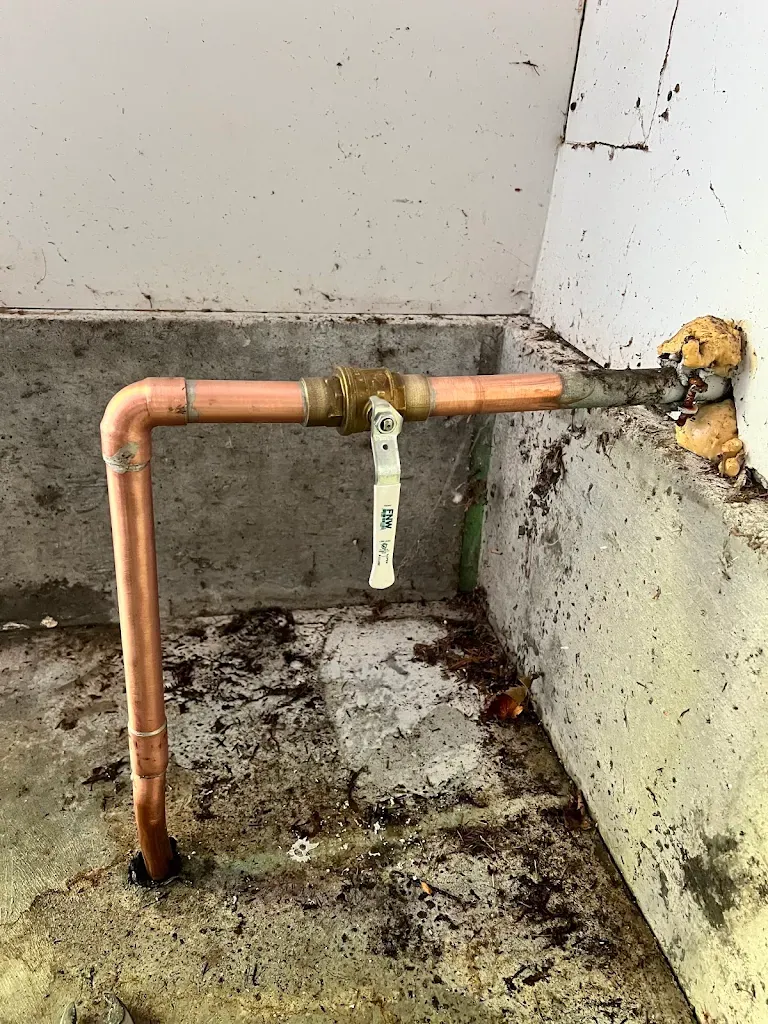
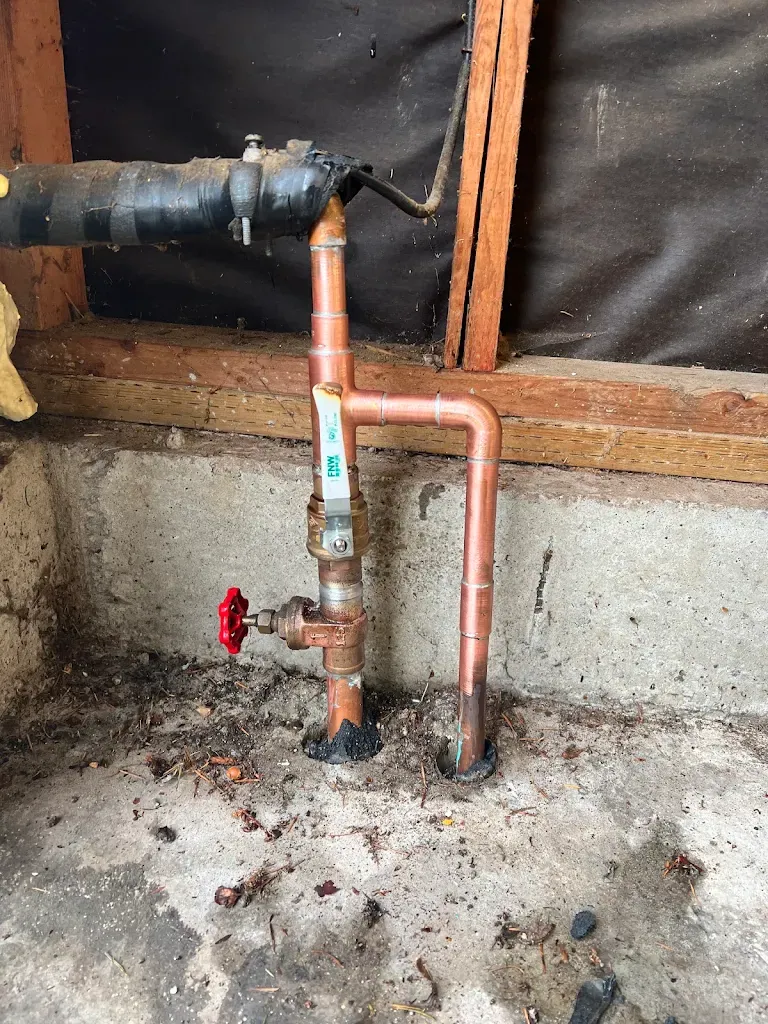
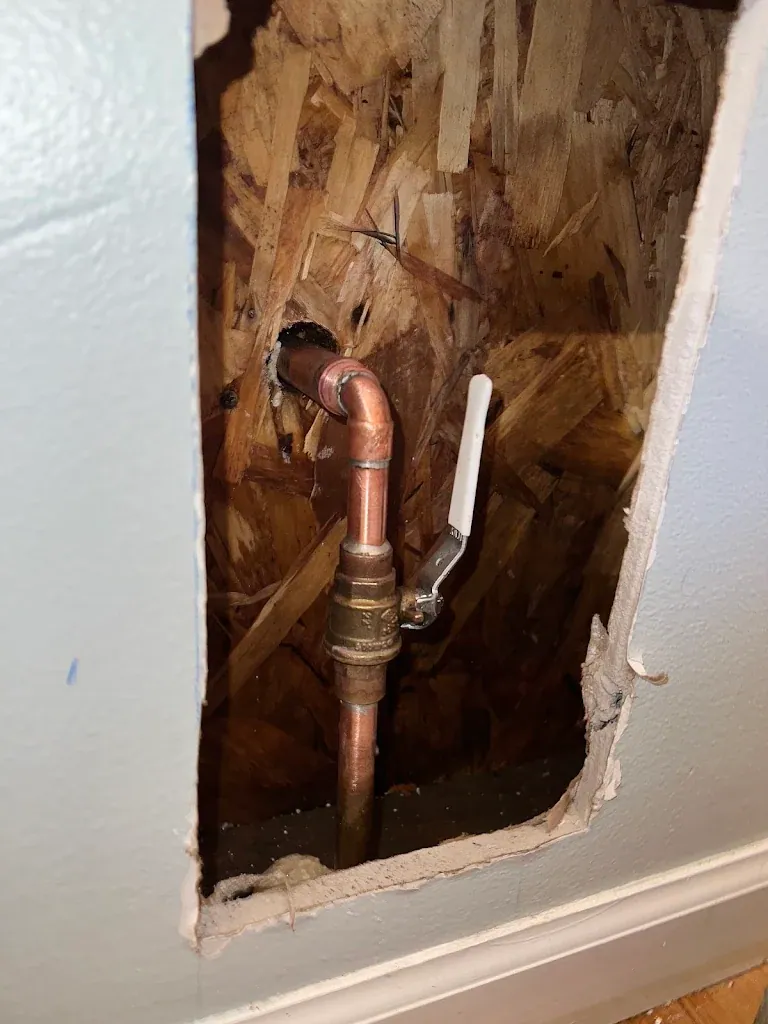
This is one of the smaller jobs we do and one of the most worthwhile. The photos on this page show typical replacements: a new ball valve soldered into a copper main in a crawlspace, a re-plumbed entry along a concrete wall where an old gate valve had seized, and a valve exposed in a cut-open wall. None of them took a full day. All of them will work the next time they are needed.
Why gate valves fail and ball valves do not
A gate valve closes by lowering a brass wedge into the water stream, driven by a threaded stem under the round handle. The design dates to the steam era and it was the standard residential shutoff through the 1980s. The trouble is that the stem threads corrode, the wedge collects mineral scale on its seat, and the packing around the stem dries out. A gate valve that has not been turned in twenty years is usually one of three things: frozen open, frozen partly open, or willing to turn but leaking at the stem once it does.
Worse, a gate valve can fail in a way that fools you. The handle turns, the stem rises, but the wedge has broken off and stays down in the pipe. The valve feels closed and is not. Or the wedge closes but the seat is so scaled that water keeps passing. We see both on calls where a homeowner swears the water is off and the pipe is still spraying.
A ball valve has a drilled brass ball that rotates a quarter turn. The handle position tells you at a glance whether it is open or closed, there is almost no stem to corrode, and a full-port ball valve has the same inside diameter as the pipe, so it does not choke flow. The ones we install are lead-free brass with a lever handle, and they will still turn freely in thirty years.
Where the main shutoff usually is, and where it ought to be
In most Port Orchard, Bremerton and Gig Harbor homes with a crawlspace, the main valve is just inside the foundation where the service line comes up, which means it is under the house, through a hatch, past the insulation, in the dark. In newer homes it is in the garage or a utility room. Slab homes in Tacoma and Lakewood often have it in a closet or outside against the foundation. Well homes have it at the pressure tank. Some homes have no valve at all except the curb stop in the meter box at the street.
A shutoff that only a plumber on his belly can reach is not much of an emergency valve. When the existing valve is in a crawlspace, we will quote two options: replace it where it is, or run the line a few feet farther and install the new valve where it comes up through the floor into a closet, laundry room or garage wall. The second costs a bit more and is worth it for anyone who is not comfortable crawling under their house with water spraying.
While we are at it we add a boiler drain or hose bib on the house side of the new valve. That small fitting lets you or us drain the whole plumbing system in a few minutes, which matters for winterizing a cabin, for freeze protection in a vacant house, and for any future repair that needs the lines empty.
- Crawlspace entry: replace in place, or extend the line and relocate into living space
- Garage or utility room: replace with ball valve and add a drain
- Exterior wall or meter box: replace, insulate, and consider a second valve indoors
- Well homes: new ball valve at the pressure tank outlet with a drain
- No house valve at all: install one at the entry so the curb stop is not the only option
Replacing a valve on a live main
The challenge with a main valve is that you cannot shut off the water upstream of it from inside the house. On municipal water we close the curb stop in the meter box with a meter key, which is a legal thing for a licensed plumber to do; the utility prefers we do it carefully and leave it as we found it. On a well we shut the pump breaker and drain the pressure tank. Either way, we drain the house down through the lowest faucet before cutting.
On copper we cut the old valve out, clean and prep the pipe, and solder or press in the new ball valve with a short section of new copper where needed. Where the existing pipe is galvanized steel we cut back to good threads or, more often, transition to copper or PEX with a dielectric fitting so the old steel and new brass are not fighting each other. On polyethylene service lines we bring the pipe up through the foundation with a proper insert fitting and a transition to copper for the valve itself.
Then the water comes back on slowly, every joint is checked under full pressure, and the new valve is cycled closed and open several times so you can see it work. The whole thing is typically a couple of hours, and the water is off for less than that.
Valves, drains and one more thing worth considering
A new main valve is the right moment to look at what sits next to it. A pressure reducing valve that has drifted, a water meter box full of mud, a service line that is galvanized right up to the valve, a missing expansion tank on the water heater: we point these out and quote them separately, and you decide what gets done now.
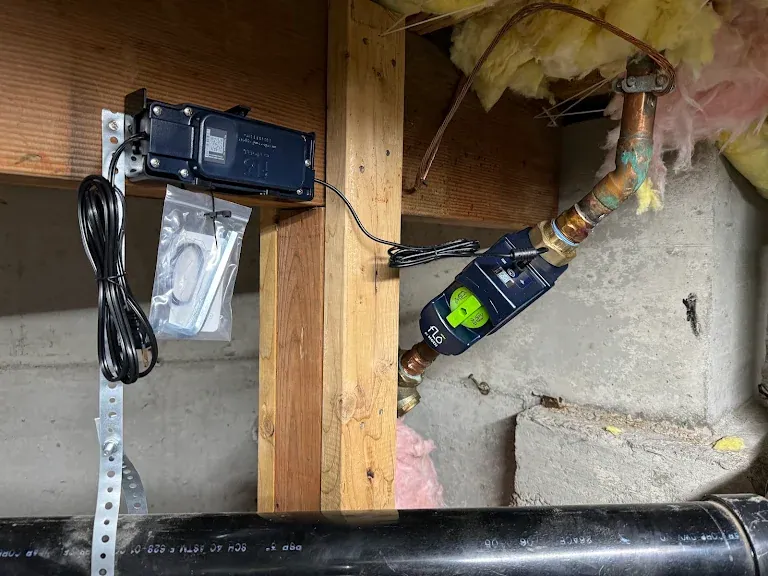
For some homes the right upgrade is a smart shutoff downstream of the new manual valve. A Flo by Moen on the main watches flow around the clock, learns the household's pattern, and closes itself when it sees a pipe running at three in the morning. For second homes on Hood Canal and the Key Peninsula, rentals, and anyone who travels, it turns the shutoff from something you have to remember into something that remembers for you. The manual valve stays, because a smart valve still needs a manual one above it for service.
What this costs and why it is worth doing before you need it
A simple main valve replacement is a modest service call, quoted flat before we start. Relocating the valve into living space, transitioning from galvanized, or adding a drain and insulation raises it somewhat, and we show each piece as its own line so you can see what you are paying for.
The reason to do it on a calm Tuesday rather than during a flood is simple arithmetic. A seized valve discovered during a burst pipe means water running for the extra half hour it takes to find the meter key, open the box, and hope the curb stop turns. A working ball valve means the water is off before you hang up the phone. One of those outcomes involves a restoration company.
Signs you need main water shutoff valve replacement
Call if you notice
- The main valve handle spins without closing the water
- The handle is missing, broken or corroded solid
- The valve closes but water still runs at the faucets
- Water weeps from the valve stem when it is turned
- The only shutoff you can find is in the crawlspace or the meter box
- The valve is a round-handle gate valve on a house built before 1990
- Green or white crust has formed on the valve body
- A plumber or inspector told you to replace it and you have not yet
- You are buying or selling a home and the valve has never been tested
How a main water shutoff valve replacement call goes
Find and test the existing valve
We locate the shutoff, check whether it actually closes by watching the meter or a faucet, and inspect the pipe on both sides for galvanized steel, corrosion or past repairs.
Flat price with options
Replace in place, or relocate into the garage or living space. A drain, insulation, a dielectric transition or a smart shutoff are priced as separate items you can add or skip.
Shut water at the source
Curb stop at the meter on municipal water, pump breaker and tank drain on a well. The house is drained down through the lowest faucet before any cutting.
Cut out the old, install the new
Full-port lead-free brass ball valve soldered or pressed into copper, with a transition fitting where the old pipe is steel or poly. A boiler drain goes on the house side.
Refill, test, demonstrate
Water restored slowly, every joint checked under pressure, and the new valve cycled while you watch so you know exactly how it feels when it is closed.
Questions we get about main water shutoff valve replacement
My main shutoff will not turn. Can I force it?
Please do not. A corroded gate valve stem snaps under a wrench, and a broken stem can leave the valve stuck partly open with no way to close it except at the street. If it will not move by hand with moderate effort, leave it and call us. In an emergency, use the curb stop at the meter instead.
Where is the main water shutoff in my house?
Usually where the service line enters: a crawlspace near the foundation, a garage or utility wall, a closet on a slab home, or next to the pressure tank on a well home. If you cannot find one, there may not be one, and the curb stop at the meter box is your only option until we install a valve.
Can I shut off water at the meter myself?
In most of Kitsap and Pierce County, yes, with a meter key or a long screwdriver on the curb stop, and we will walk you through it on the phone in an emergency. Some utilities ask that you not operate it routinely. A working valve at the house is a better answer for everyday use.
How long is the water off during a valve replacement?
Usually an hour or two. We drain the house, cut, install, and refill in one visit. You will have water again before the afternoon.
Should I replace a gate valve that still works?
If it is more than twenty-five or thirty years old, we would. A gate valve that works today may not after one more year of sitting still, and the failure happens when you need it most. The replacement is a modest job on a calm day and an expensive lesson during a flood.
Can you move the shutoff out of the crawlspace?
Yes. We extend the line a short distance and bring the new valve up into a closet, laundry room or garage wall where it can be reached standing up. It costs somewhat more than replacing in place and is worth it for most homeowners.
Is a smart shutoff a replacement for a manual valve?
No, it goes downstream of one. The manual ball valve lets us service the smart valve and gives you a fallback if the power or network is out. We install Flo by Moen units on many homes right after replacing the main valve.