
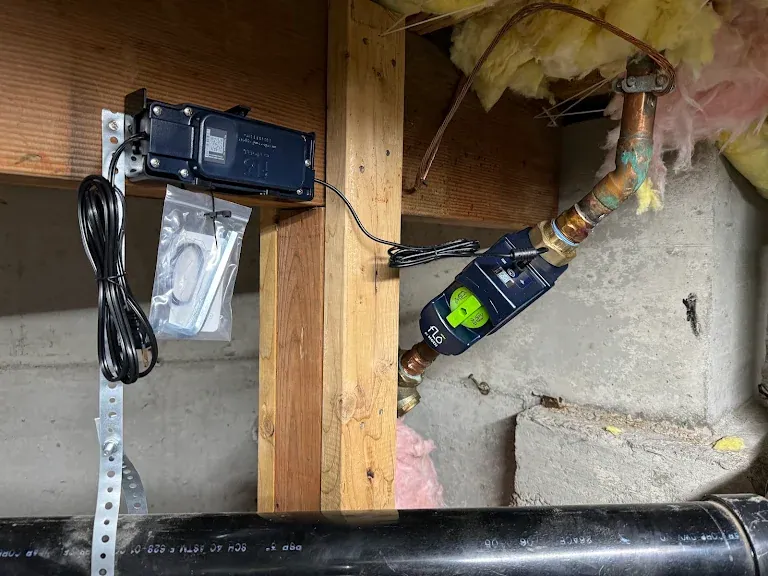
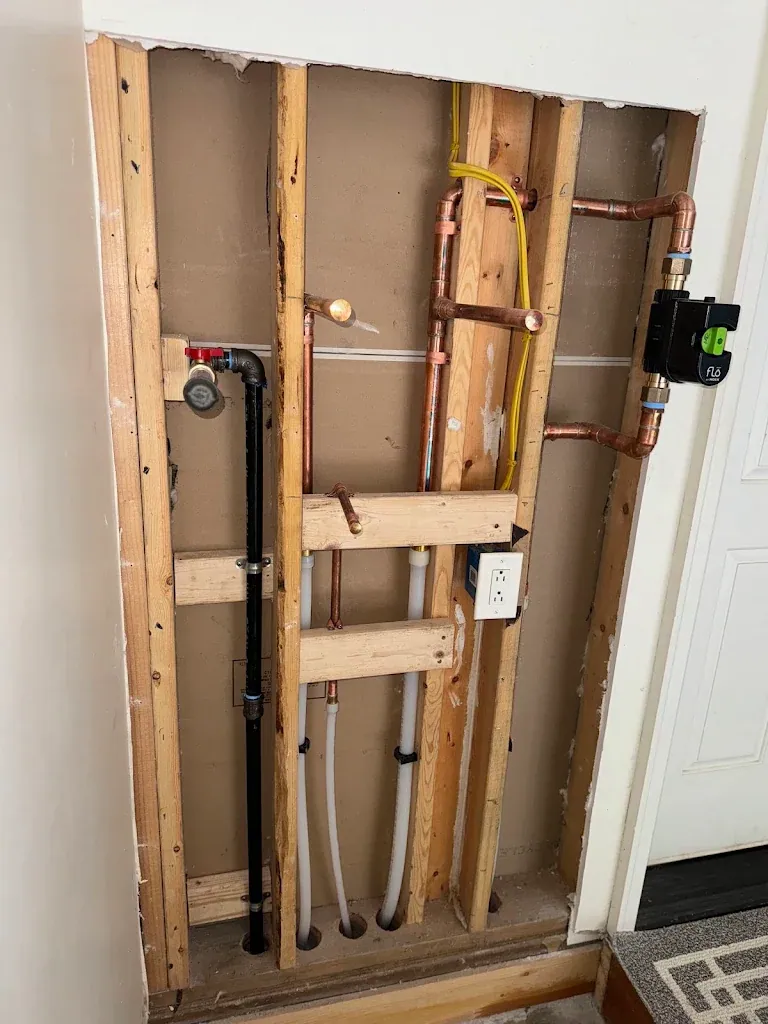
Washington Plumbing & Drain installs Flo by Moen smart water shutoffs and leak sensors across Kitsap, Pierce and Mason counties. We put them on primary homes near Port Orchard and Gig Harbor, on second homes and rentals around Belfair, Union and the Key Peninsula, and on new construction and repipes where the valve goes in alongside the rest of the plumbing. The photos on this page show a Flo mounted on a copper main in a crawlspace and another in an open wall during a rough-in.
The device is only as good as its installation. It needs a manual valve ahead of it, clean straight pipe, a power source that does not share a circuit with the Christmas lights, and a signal strong enough to reach the crawlspace. Those are plumber problems, and they are why a unit bought online and hung by a handyman ends up in a drawer.
What a smart shutoff actually watches
The Flo by Moen valve is a motorized ball valve with a flow meter, a pressure sensor and a temperature sensor built into one body, installed on the main line just after the manual shutoff. It measures every gallon that enters the house and the pressure behind it, continuously. Over its first week or two it learns the household: the morning showers, the dishwasher at nine, the irrigation on Tuesdays, the long stretch of nothing overnight.
Once it knows the pattern, it reacts to departures from it. A toilet supply line that lets go and runs at full flow for more than a few minutes, a line that runs continuously from midnight to four, a washing machine hose that bursts and dumps ten gallons a minute: each one trips a rule, the valve closes, and the app notifies you. You can override from your phone if it was a legitimate use, and the system gets smarter about what is normal in your house.
It also runs a quiet health test every night. With the house asleep, the valve closes briefly and watches the pressure on the house side. If pressure drops, water is leaving the system somewhere, even a drip. That is how these devices catch the slow leaks that no sensor on the floor would ever see: a pinhole in a crawlspace line, a running toilet, a weeping fitting behind a wall.
Sensors on the floor for the leaks the valve cannot see
The valve on the main catches supply leaks, which are the ones that run under pressure and show on the flow meter. It cannot see a water heater tank that is rusting through, a drain leak under a shower, a sump pump that failed during an atmospheric river, or groundwater coming into a crawlspace. For those, battery-powered leak sensors sit on the floor at the likely spots and talk to the same app.
We put them in the water heater pan, under the kitchen sink, behind the washing machine, under the upstairs bathroom if there is a finished ceiling below, at the sump pit, and near the crawlspace access on homes that have had groundwater before. A sensor detecting water can be set to close the main valve automatically, which is the right call for a water heater or a washer, or just to alert you, which is better for a sump or a crawlspace where closing the main would not help.
Sensors are cheap and quick to add. The valve is the part that needs a plumber, and the sensors are the part that makes the system cover the whole house instead of just the supply side.
- Water heater pan: valve closes on detection
- Washing machine and dishwasher: valve closes on detection
- Under sinks and behind toilets: alert, close if desired
- Sump pit and crawlspace: alert only, since the water is not from the supply
- Second-floor bathrooms over finished ceilings: alert and close
Installing it so it works for years
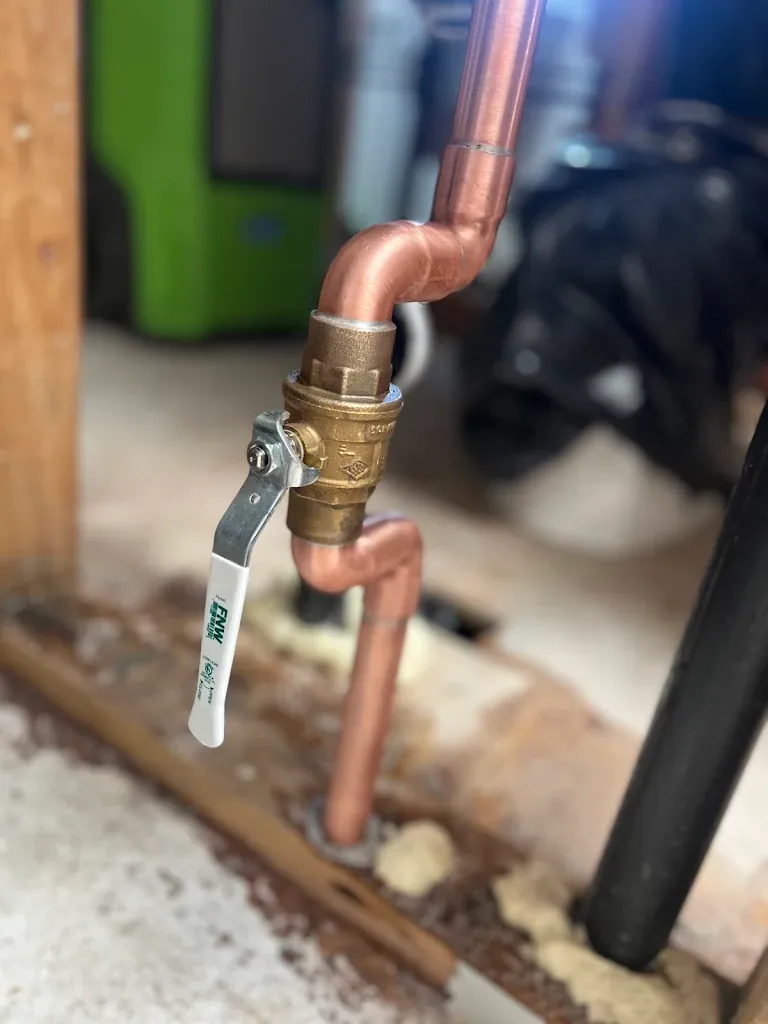
The valve goes on the main just downstream of a working manual ball valve, and if the existing shutoff is a seized gate valve we replace it first, because every smart valve needs a dumb one ahead of it for service and as a fallback. It needs a stretch of straight pipe on both sides for the flow meter to read accurately, a size that matches the service line, and a mounting that supports its weight rather than hanging it off the pipe. In copper we solder or press it in with unions; on a PEX or poly main we transition to copper for the valve body.
Power is the second half. The unit runs on a wall adapter, so there needs to be an outlet within reach, ideally on a circuit that stays on when someone trips the garage breaker. In a crawlspace that often means having an electrician add a receptacle, which we coordinate, or routing the low-voltage cable up to one in the house. We mount the controller where it can be seen and reached, as in the photo on this page where it sits on a joist near the access.
Then the signal. Crawlspaces and detached pump houses are hard on Wi-Fi, and a valve that cannot reach the network cannot send an alert. We test the signal at the mounting spot before committing and recommend a range extender when it is marginal. The app walks through setup, and before we leave we trigger a test shutoff so you can see the valve close, feel it on the handle, and watch the notification land on your phone.
Who gets the most out of a smart shutoff around here
Second homes are the obvious case. Hood Canal, Lake Cushman, the Tahuya river cabins, Fox Island, Hansville: all places where a house sits empty midweek through a freeze and a burst pipe can run until the weekend. A smart valve closes the water in the first minutes and tells you, so the damage is a wet corner instead of a gutted house. Many owners pair it with an away mode that closes the valve on any flow at all while they are gone.
Rentals and property management are next. A tenant may not notice a running toilet or a weeping water heater for weeks, and the owner certainly will not. The valve and sensors catch it, and the nightly pressure test flags slow leaks before the water bill does. Insurance carriers increasingly ask about leak protection and some discount for it, which is worth a question to your agent.
Primary homes benefit too, especially anyone who travels for work, which covers a lot of Naval Base Kitsap and shipyard families deployed or on rotation. Older homes with aging copper, homes that have already had one leak, and homes with finished basements or hardwood floors over a crawlspace all have more to lose and more reason to let the house watch itself.
What it does not do, and what to expect
A smart shutoff does not prevent a pipe from freezing, does not stop groundwater, and does not replace a working manual valve. It will not fix a leak; it stops the water so the leak does not become a disaster. It also needs power and a connection, which is why the manual valve stays and why we talk about a battery backup for the controller in homes where outages are routine, as they are on Peninsula Light and Mason PUD lines during winter windstorms.
Expect a few false alarms in the first weeks while it learns. Filling a hot tub, running irrigation for the first time, or a long shower by a houseguest can trip a rule, and the app lets you tell it that was fine. After that it settles in. The install itself is typically a half day including a manual valve replacement, and the device, the plumbing and the setup are quoted as one flat price before we begin.
Signs you need smart leak detection & automatic shutoff
Call if you notice
- You own a cabin, second home or rental that sits empty for days
- You travel or deploy and nobody is home to notice a leak
- The house has had a burst pipe or a hidden leak before
- The plumbing is original copper or has known weak points
- A finished basement, hardwood floors or valuable contents sit below the plumbing
- Your insurance carrier asked about leak protection or offered a discount
- The current main shutoff is hard to reach or does not work
- You want to know about a running toilet before the water bill tells you
- An elderly relative lives alone and might not catch a leak quickly
How a smart leak detection & automatic shutoff call goes
Look at the main and the space
We check the existing shutoff, the pipe material and size, the straight run available, and where power and Wi-Fi are in relation to the entry. If the manual valve is bad, replacing it is part of the plan.
Flat price for valve, sensors and setup
The smart valve, a manual ball valve if needed, the sensors you want, any transition fittings, and the app setup are quoted as one number before work begins.
Plumb it in with unions and support
The valve is soldered or pressed into copper downstream of the manual valve with straight pipe on both sides, mounted so its weight is carried, and the controller placed where it can be reached.
Power, signal, pairing
We connect power, confirm the Wi-Fi signal at the valve, pair the unit and the sensors to your phone, and set the away mode and sensor rules the way you want them.
Test shutoff while you watch
We trigger a leak event, the valve closes, the notification arrives, and you see how to reopen it from the app and by hand. You leave knowing exactly what the system will do.
Questions we get about smart leak detection & automatic shutoff
What does a Flo by Moen actually do when it detects a leak?
It closes the motorized ball valve on your main, stopping all water into the house, and sends a notification to your phone explaining why. You can reopen it from the app if the flow was legitimate, or leave it closed until the leak is fixed.
Will it shut the water off while I am in the shower?
Not once it has learned your house. The first week or two it may be cautious, and a very long shower or filling a hot tub can trip a rule. The app lets you mark that as normal, and it adjusts. You can also loosen the sensitivity.
Does it work during a power outage?
The valve holds its last position without power, so if it was open it stays open and if it closed it stays closed. It cannot detect or close during an outage unless it has a battery backup, which we recommend for homes on lines that lose power in windstorms. The manual valve ahead of it always works.
Can it catch a slow leak, like a drip behind a wall?
Yes, that is one of its best features. Every night it closes briefly and watches system pressure. If pressure drops with nothing running, water is leaving somewhere, and it flags it. That catches pinholes, running toilets and weeping fittings long before they show.
Does it replace my main shutoff valve?
No. A manual ball valve goes ahead of it, both so the smart valve can be serviced and so you have a fallback. If your existing shutoff is a stuck gate valve, we replace it as part of the install.
Can you add this to a new water heater or a repipe?
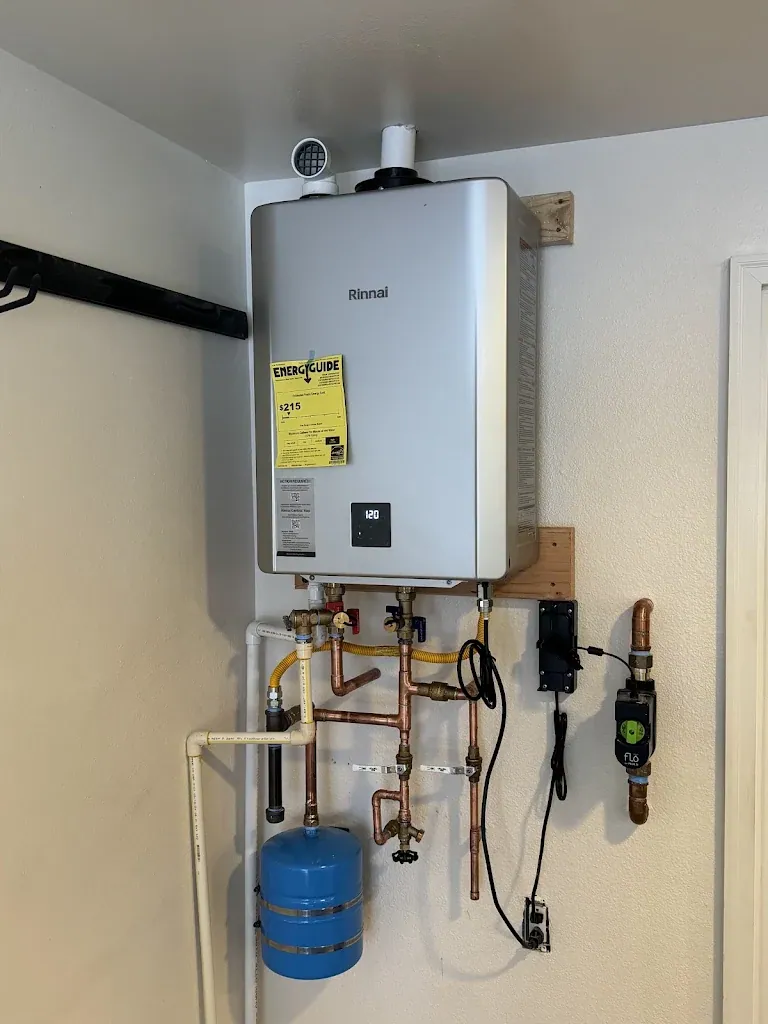
Yes, and it is the easiest time to do it. We routinely install a smart valve alongside a Rinnai tankless or during a whole-house repipe, as the photos on this page show, and the plumbing is already open so the cost is lower.