
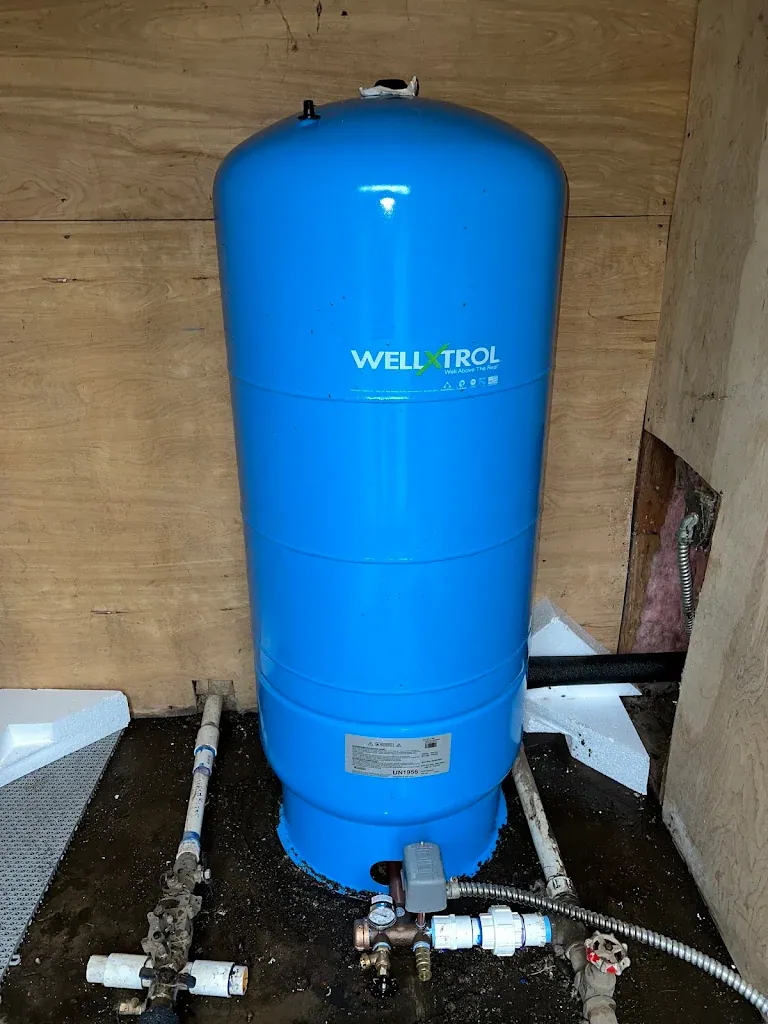
Washington Plumbing & Drain repairs and rebuilds the plumbing inside well houses. We replace waterlogged pressure tanks with Well-X-Trol and Amtrol tanks, swap failed pressure switches and gauges, replace check valves and unions, add filtration after the tank, and insulate and heat the building so it survives the next hard freeze. Switches, gauges, tank tees and fittings ride on the truck so a Saturday call does not turn into a Monday job.
One thing we want to be plain about: we do not pull or replace the pump itself. The submersible down the casing, the drop pipe and the pitless adapter belong to a well pump company. We diagnose at the well house, fix what is ours to fix, and tell you clearly when what you need is a pump outfit instead of a plumber.
What lives inside a well house
Walk into a typical pump house in Kitsap or Mason County and you will find a steel tank the size of a water heater, a small gray box with a pressure switch on a short nipple, a gauge beside it, a tank tee with a relief valve, and a run of copper or PEX heading out through the wall toward the home. Some have a check valve on the incoming line, a sediment filter, a manifold feeding a hose bib or a yard hydrant, and a heat lamp hanging from a nail that someone meant to replace years ago.
The pump pushes water into the tank, where it compresses a cushion of air behind a rubber bladder. When the gauge climbs to the cut-out setting on the switch, usually 50 or 60 psi, the switch opens and the pump stops. You draw stored water out of the tank until pressure falls to cut-in, and the switch calls the pump again. Every piece in that building exists to give the pump a rest between starts, because pump motors die from starting, not from running.
That is why a well house matters so much. A tank that has lost its air charge, a switch with burned contacts or a check valve that leaks back down the well all force the pump to work harder than it was built for. We can fix all three in a morning. The pump they protect is a different trade.
Why well houses fail around here
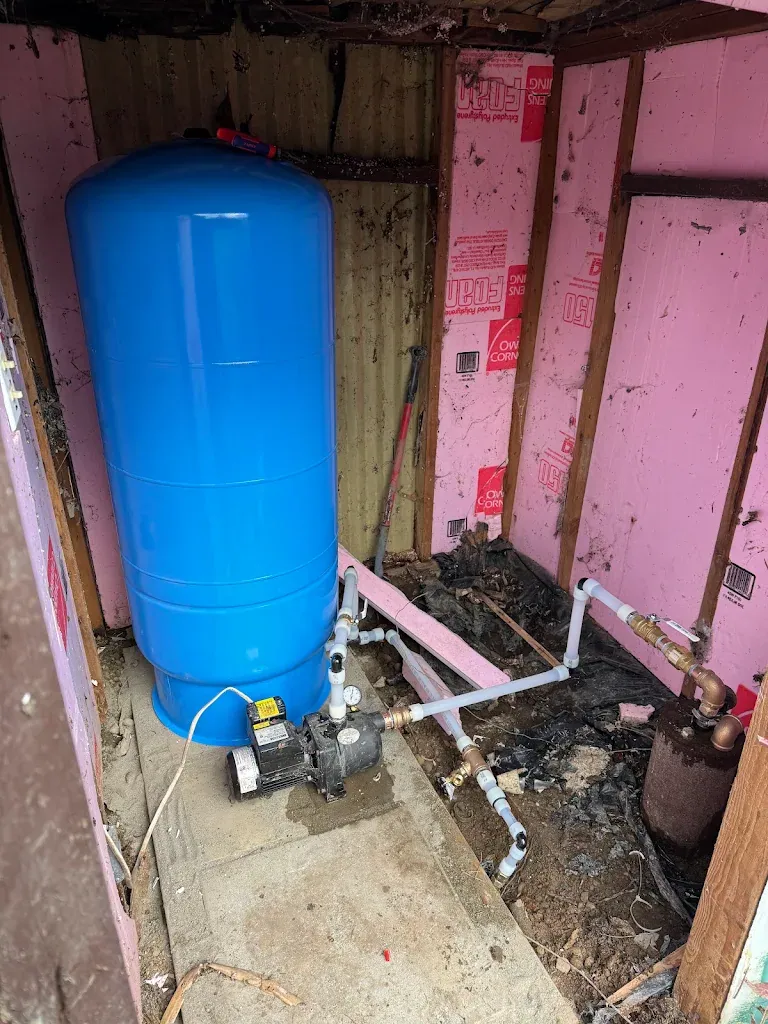
Cold is the first reason. A pump house is usually an unheated shed with a thin door and a slab floor, and the December 2022 freeze and the January 2024 cold snap split tank tees, cracked gauges and burst supply lines in well houses from Hansville to Hoodsport. A heat lamp with a burned-out bulb or a door left ajar during a wind storm is all it takes. Once the line to the house freezes, the pump runs against ice until the overload trips or the pressure switch gives up.
Water is the second. Iron and manganese in local groundwater pack the small nipple under the pressure switch with sludge until the switch can no longer feel the real pressure. Sand wears the seat on the check valve. The steel tank rusts from the inside, and a damp slab rusts it from the outside. Tanks that the manufacturer rates for fifteen years often give up at eight on a Mason County well.
Neglect finishes the job. A well house gets opened once a year, if that, and mice and wasps move into the switch cover in between. By the time anyone looks, the tank is waterlogged, the gauge is stuck, the relief valve weeps and the pump has been short cycling for months.
Waterlogged tanks and short cycling
The call we get most on a well is a pump that clicks on and off every few seconds while a shower runs. That is short cycling, and the tank is waterlogged nine times out of ten. The bladder tore or the precharge leaked out through the air valve, so there is no cushion and the pressure swings from cut-in to cut-out almost instantly. You can check it yourself by tapping the tank from top to bottom. A healthy tank sounds hollow on top and dull low down. A waterlogged one sounds dull all the way up.
Short cycling is a slow way to kill a pump. Every start draws several times the running current and heats the motor windings, and a motor meant to start a few thousand times a year starts that many times a month. We have been to well houses where the tank should have been swapped two winters earlier and the owner is now facing a pump bill on top of a tank bill.
Replacing a pressure tank is a half-day job for us. We size the new tank to the pump's output and the home's demand rather than to whatever was there before, set the precharge two psi below cut-in with the system drained, and write that number on the tank. The tank tee, switch, gauge and relief valve go in new as a set because they are the same age and fail together.
Pressure switches, gauges and check valves
A pressure switch is a cheap part with an expensive failure. Pitted contacts make the pump stutter on and off. A clogged nipple under the switch leaves it blind, so the pump either will not start or will not stop. We replace the switch, the nipple and the gauge together on every visit, because the gauge is the only way you will ever know what the system is doing, and a stuck gauge hides the next problem.
We also set the switch to match the house. A single-story cabin can run 30/50. A two-story home with a long run from the well house, a filtration system or an upstairs shower usually wants 40/60, and the tank precharge has to move with it. Those two settings are adjusted together or not at all.
A check valve that leaks lets pressure bleed back down the well, so the pump cycles even when every faucet in the house is closed. Sometimes the check valve is in the well house where we can replace it in an hour. Sometimes the leak is below ground at the pump. We isolate the system to tell you which, and if the answer is the pump, we say so.
Insulating and heating a well house
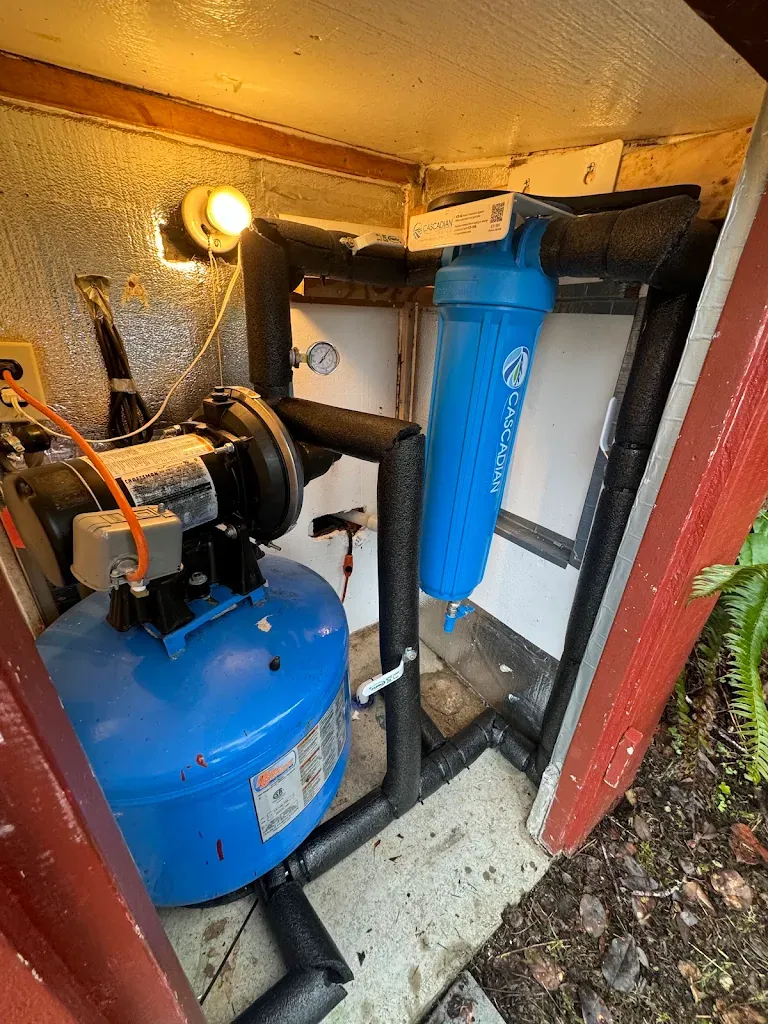
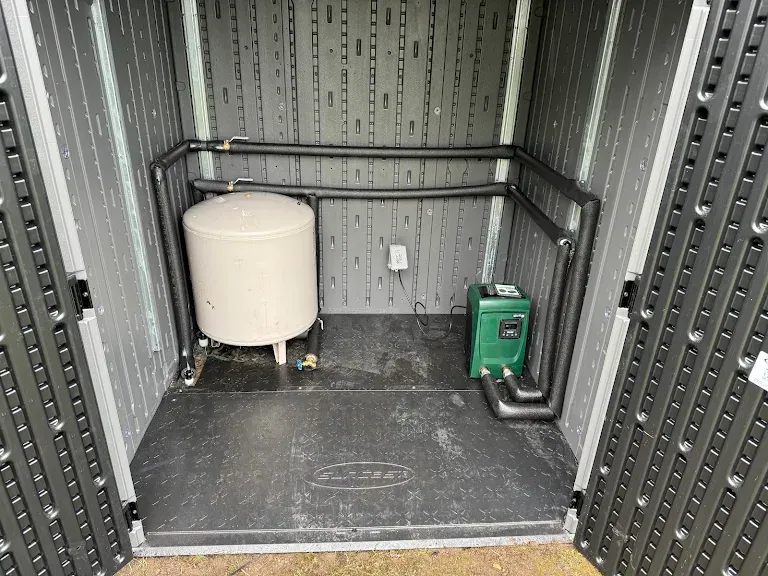
Freeze protection is the cheapest well work there is, and it is the work most often skipped. We wrap every line in the building with closed-cell insulation, install thermostatic heat tape on the exposed runs, set the tank on a stand off the slab, and seal the gaps around the door and the pipe penetrations where wind pushes cold in. Where the building is too open to hold heat, we will tell you it needs a small thermostat-controlled heater rather than a bare heat lamp.
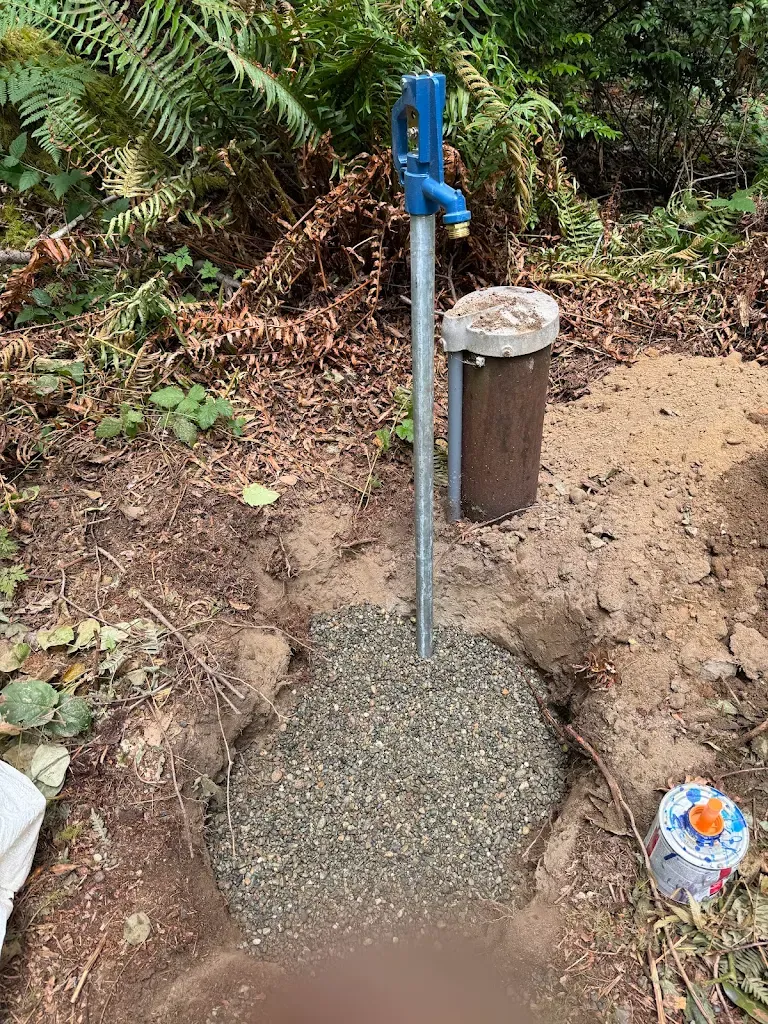
The line from the well house to the home deserves the same attention. On a lot of older properties it leaves the building above grade, drops a few inches and runs under the yard at a depth that was fine in 1975. We insulate and box the exposed section, and where the run is shallow and keeps freezing, we talk through lowering it or sleeving it.
Rebuilding the plumbing in an old well house
Plenty of well houses in the county have been patched one fitting at a time for forty years: a galvanized tee here, a compression coupling there, a gate valve that no longer closes, a tank sitting directly on wet concrete. When enough of it is tired, the right answer is to rebuild the manifold as one job. New tank, new tee and switch cluster, ball valves and unions on both sides so the next person can isolate the tank without draining the house, a boiler drain for winterizing, and copper or PEX run cleanly along the wall where heat tape can reach it.
This is also when filtration or a booster makes sense. A sediment filter, Cascadian or Halo whole-house treatment, or iron and UV equipment goes in after the pressure tank, sized so it does not strangle the flow. A home on a hill above the well house or a shop at the far end of the property sometimes wants a DAB booster after the tank. We size and plumb those, and we will say when a switch adjustment would have done the job for less.
What we do not do, and who does
We do not pull, replace or troubleshoot the pump itself. That includes the submersible or jet pump, the drop pipe, the pitless adapter, the control box and anything down the well casing. Pulling a pump takes a hoist, a rig and well-specific tools, and the companies that do it every day do it better than a plumber with a pipe wrench would.
What we do is get you a clear answer about which side of the line the problem is on. If the breaker holds, the switch is good, the tank is healthy and the check valve is tight but the gauge still sits at zero, the pump is the suspect. We will tell you that plainly, give you the name of a well pump company we trust, and come back to finish the well house side once the new pump is set. Nobody pays us to replace a tank that was never the problem.
Signs you need well house & pressure tank service
Call if you notice
- The pump clicks on and off rapidly whenever a faucet is running
- Water pressure surges and sags in the shower
- The pressure tank sounds dull or heavy when you tap near the top
- Air spits from the faucets before the water runs
- The pump cycles at night with every fixture in the house closed
- Rust streaks, a weeping relief valve or a pinhole on the tank or tank tee
- The gauge in the well house is stuck, fogged or reads nothing
- Lines in the well house froze last winter and the building has no heat
- The well house plumbing is a patchwork of old fittings and valves that no longer close
How a well house & pressure tank service call goes
Tell Corinne what the system is doing
No water, low water or cycling, and whether the tank is in a well house, a garage or a crawlspace. That tells Greg which tank sizes and switches should be on the truck.
Diagnose at the well house
We check the breaker and the switch, read the gauge, test the tank precharge and bladder, and isolate the system to confirm the check valve holds. You get a plain answer on whether the problem is in the building or down the well.
Flat price on your phone
Whether it is a switch and gauge, a new pressure tank, a full manifold rebuild or a referral to a well pump company, the price is written and approved before any work starts.
Replace the cluster, not just the part
A new tank gets a new tee, switch, gauge, relief valve, unions and an isolation valve. The precharge is set to the switch and written on the tank.
Run it through its cycles
We fill the system, bleed air from the house, time the cycles under load and set the switch so pressure is right at the farthest fixture.
Winter and maintenance advice
Insulation, heat tape, filter changes and what the gauge should read on a normal day, so you catch the next problem before the pump pays for it.
Questions we get about well house & pressure tank service
My pump turns on and off constantly. What is wrong?
Almost always a waterlogged pressure tank. The air cushion is gone, so the pump cycles every few seconds. It needs attention soon, because short cycling burns out pumps and switches. A new tank is a half-day job and far cheaper than what it protects.
Do you pull or replace well pumps?
No. The pump, the drop pipe, the pitless adapter and the control box are well pump company work, and we will tell you when that is what you need. We handle everything plumbed inside the well house and the line from there to the home, and we are glad to coordinate with the pump company so the whole system is right when they leave.
How do I know if my pressure tank is bad?
Tap it from top to bottom. A good tank sounds hollow above the waterline and dull below. A bad one sounds dull everywhere. With the pump off and the system drained, the air valve on top should hold pressure; if water comes out of it, the bladder is torn.
What pressure should my well be set to?
Most homes run 40/60, meaning the pump starts at 40 psi and stops at 60. Single-story homes sometimes run 30/50. A home with a second floor, a long run or a filtration system usually wants 40/60 or a little higher, and the tank precharge has to match. We set both together.
Can you keep my well house from freezing again?
Yes. We insulate every line, add thermostatic heat tape, set the tank off the slab, seal the door and pipe penetrations, and tell you when the building needs a real heater instead of a heat lamp. It is a small job compared to a split tank in January.
Can you add a sediment filter or treatment in the well house?
Yes. Sediment filters, Cascadian and Halo filtration, iron treatment and UV all go in after the pressure tank, sized so they do not choke the flow. If your water has not been tested recently we will suggest that first.
Why does my water spit air before it runs?
Either the tank bladder has failed and air is getting into the water side, or the well level has dropped and the pump is drawing air. The first is a tank job we do. The second is a conversation about the well and the pump, and we will tell you which one it is.
Can you come out after hours when the well quits?
Yes. No water is an emergency and we answer evening and weekend calls. Check the breaker first; if it holds and the gauge still reads zero, call (360) 812-1124 and we will sort out whether it is the well house or the pump.