Washington Plumbing & Drain installs expansion tanks and mixing valves as part of every water heater we put in, and as standalone jobs on heaters other people installed. A dripping relief valve, a water hammer thump when the heater cycles, a plumbing inspection that flagged a missing tank, or a family that wants more usable hot water from a fifty-gallon tank all land on this page.
Greg sizes the tank to the heater and the house pressure, sets the air charge with a gauge instead of trusting the factory number, and mounts it so it is supported rather than hanging off a nipple. Those three details are the difference between an expansion tank that works for a decade and one that fails in three years and floods a closet.
What thermal expansion does inside a closed plumbing system
Water expands when it is heated. A fifty-gallon tank warming from fifty degrees to a hundred and twenty gains about three quarters of a gallon in volume. In an old house with a plain meter and no check valve, that extra volume simply pushed back out into the street main and nobody noticed. Modern water systems are different. Pressure reducing valves, backflow preventers and the check valves built into newer meters all stop water from flowing backward, which turns your house into a closed container.
In a closed container that extra three quarters of a gallon has nowhere to go, so pressure climbs sharply every time the heater runs. House pressure that reads sixty at the hose bib can spike well above a hundred and fifty during a heating cycle. The temperature and pressure relief valve on the heater is set to open at one fifty, and it does its job: it drips. The toilet fill valves hiss, the faucet cartridges wear out, the washing machine hoses bulge, and the tank itself is being flexed thousands of times a year.
An expansion tank is a small steel vessel with a rubber bladder and an air cushion on one side. When the water expands, it compresses the air instead of straining the pipes. Washington's plumbing code has required one on any heater in a closed system for years, which is why home inspectors around Port Orchard and Gig Harbor flag their absence so often.
Signs the expansion tank is missing or has failed
The clearest sign is the relief valve. A T&P valve that drips only after a shower, or leaves a puddle in the pan each morning, is usually responding to thermal expansion rather than a bad valve. Replace the valve without addressing the pressure and the new one will drip too. We test by watching a gauge on the drain valve through a full heating cycle, which shows the spike in real time.
An expansion tank that is present but dead is almost as common. The bladder tears or the air charge leaks away, the tank fills completely with water, and it stops doing anything. Tap the tank: a working one sounds hollow on top and solid on the bottom. A waterlogged one sounds solid throughout and is noticeably heavy. Pressing the Schrader valve on a waterlogged tank squirts water instead of air.
The other failure is mechanical. A tank that was screwed onto a horizontal tee with no support eventually works the threads loose or cracks the fitting, and the result is a leak at the top of the heater that gets blamed on the heater. We mount tanks with a strap or bracket and, where the space allows, vertically with the connection on the bottom so the bladder does not sit under the tank's weight.
- Relief valve drips after the heater runs, not continuously
- A thump or bang in the pipes when the heater shuts off
- Pressure gauge on a hose bib reads over a hundred after a heating cycle
- The expansion tank is heavy and sounds solid when tapped
- Water, not air, comes out of the tank's Schrader valve
- Home inspection report lists a missing or unsupported expansion tank
Sizing and setting an expansion tank correctly
The small two-gallon tank sold at the hardware store is right for a forty or fifty-gallon heater at moderate pressure. A seventy-five or eighty-gallon tank, a high-recovery commercial heater, or a house running on the high side of pressure needs a larger vessel. We check the heater size and the actual static pressure and pick the tank from the manufacturer's chart rather than guessing.
The air charge matters more than most people realize. Out of the box the tank is pre-charged to a generic number that rarely matches the house. If the charge is lower than the house pressure, the bladder is already compressed before the heater fires and the tank has no room to absorb anything. We measure static pressure at the house, set the tank's air side to match with a hand pump and gauge, and only then screw it on. This takes five extra minutes and it is the step that gets skipped.
On homes with a pressure reducing valve, which is most of the newer construction in Silverdale, Gig Harbor North and Puyallup, we also confirm the PRV is holding its setting. A PRV that has drifted high makes every expansion problem worse and shortens the life of the new tank. Well homes with a pressure tank already have a cushion in the system and often do not need a separate expansion tank at all; we tell you when that is the case.
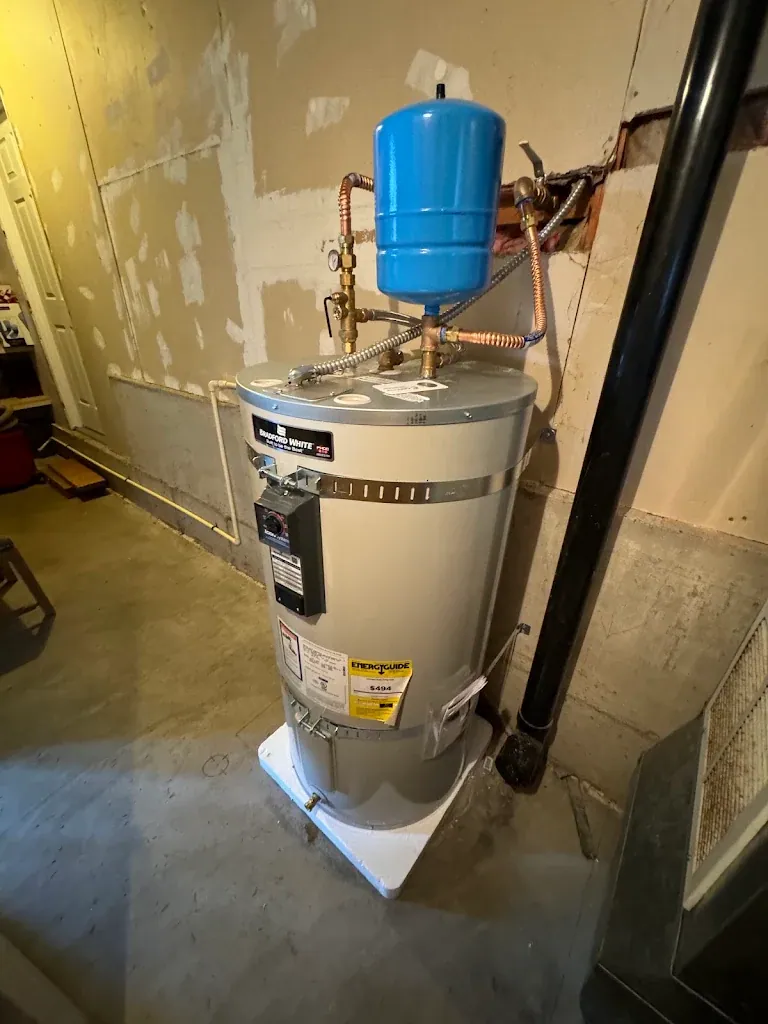
Thermostatic mixing valves and tank boosters
A thermostatic mixing valve sits on the water heater outlet and blends hot water with a little cold so the water leaving the heater holds a set temperature no matter how hot the tank is. That lets you do something useful: turn the tank up. Water stored at a hundred and forty degrees or higher stops Legionella bacteria from growing and, because it is hotter, each gallon stretches further when mixed down at the shower. A fifty-gallon tank with a mixing valve delivers roughly what a sixty-five or seventy-gallon tank would without one.
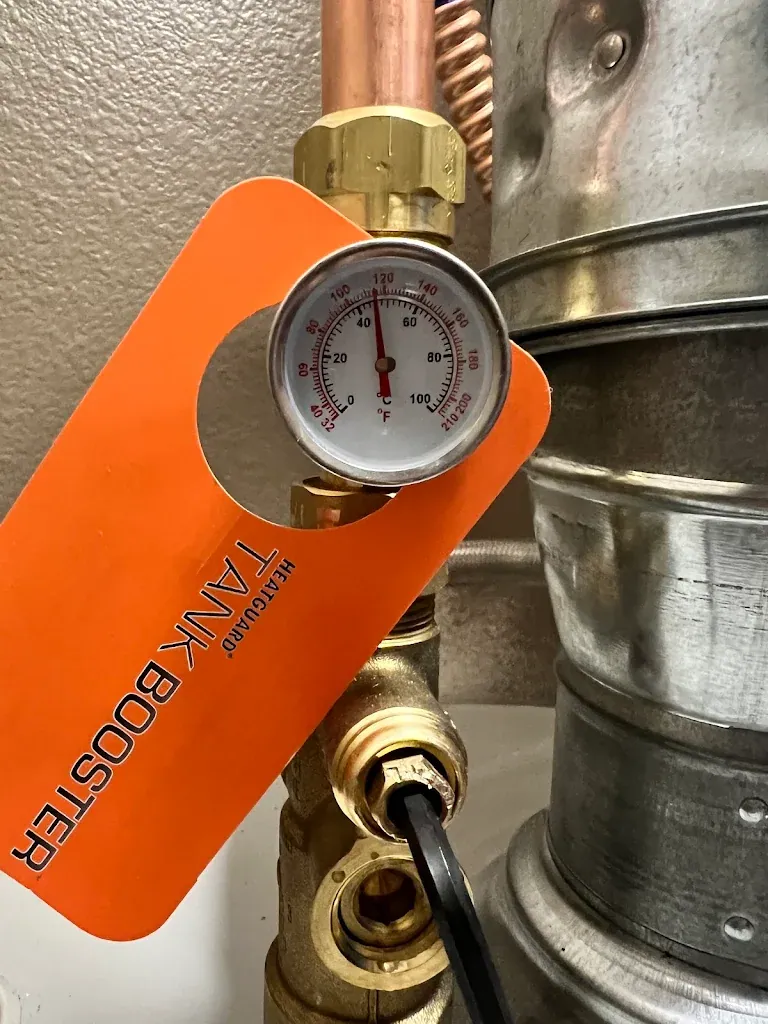
That is why they are sometimes sold as tank boosters. For a family of five in a Bremerton rambler that keeps running out of hot water, a mixing valve on the existing heater is often a better answer than a bigger tank, and it is a far smaller job. We dial it in with a thermometer at the valve outlet and again at the farthest fixture.
Mixing valves also solve a safety problem. A hundred and forty degree water scalds skin in seconds. Anywhere there are small children, elderly family members, or a tenant you cannot supervise, a mixing valve on the heater is the simplest protection you can buy, and it is required on new installations by most of the jurisdictions we work in.
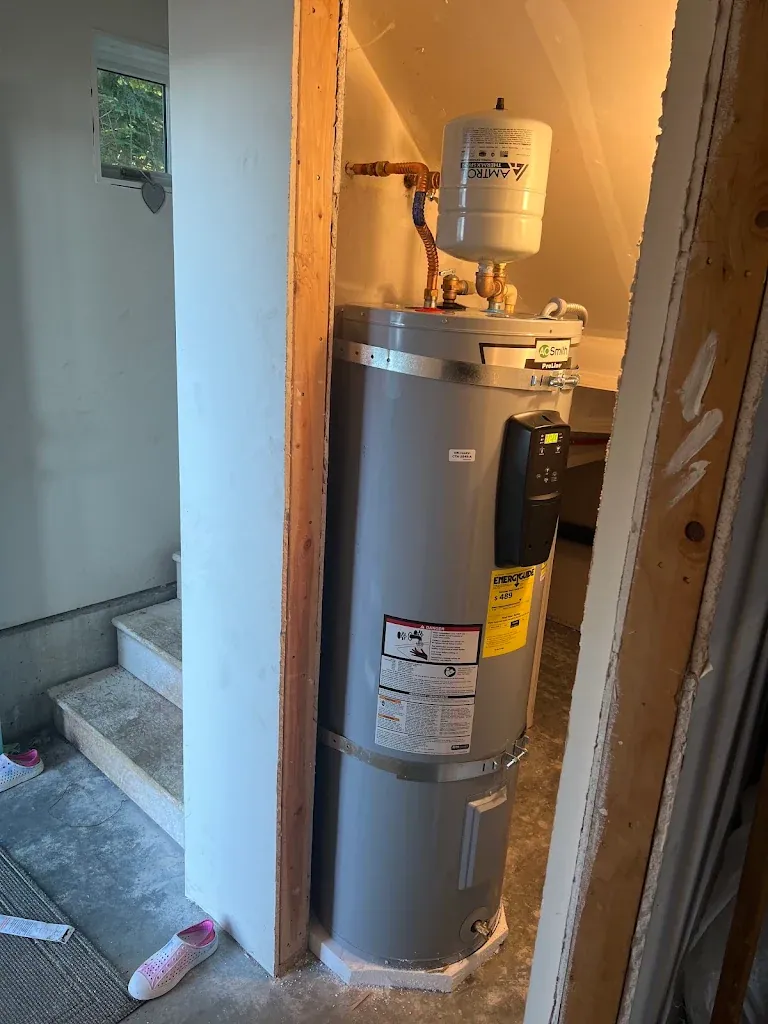
Doing both at once during a water heater replacement
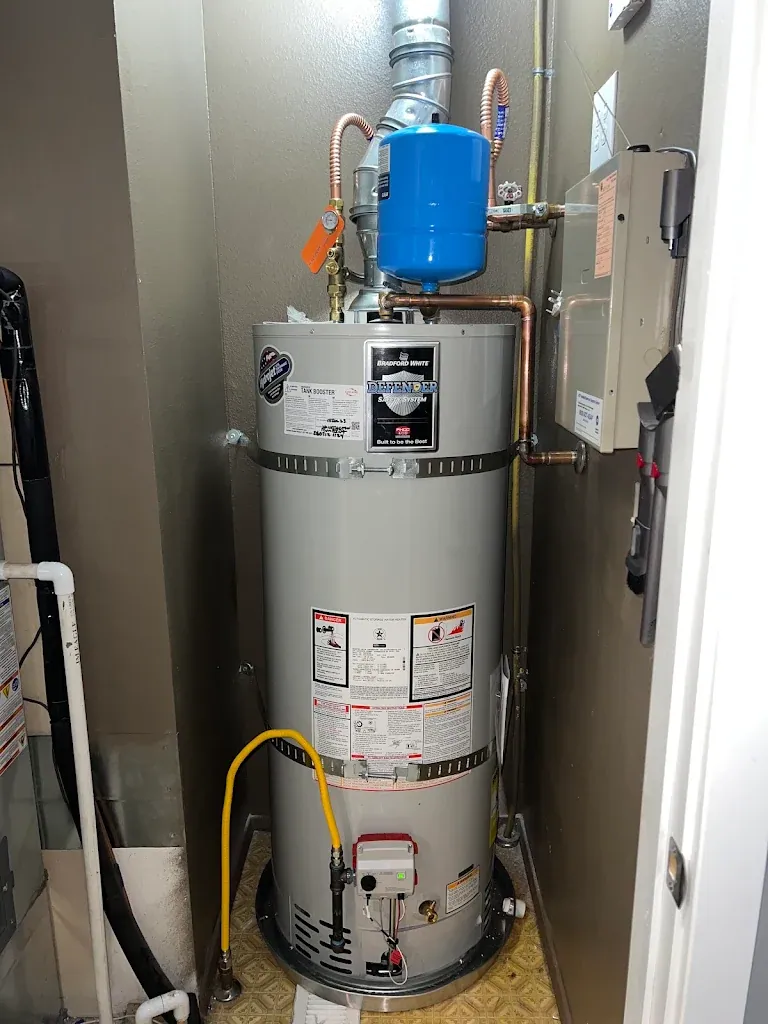
Every water heater Washington Plumbing & Drain installs leaves with a properly sized and charged expansion tank, a mixing valve where the home needs one, a drain pan, seismic straps and a new T&P valve. The photos on this page show what that package looks like in a closet, a garage and under a staircase. If another company quoted you a heater swap without these, ask why.
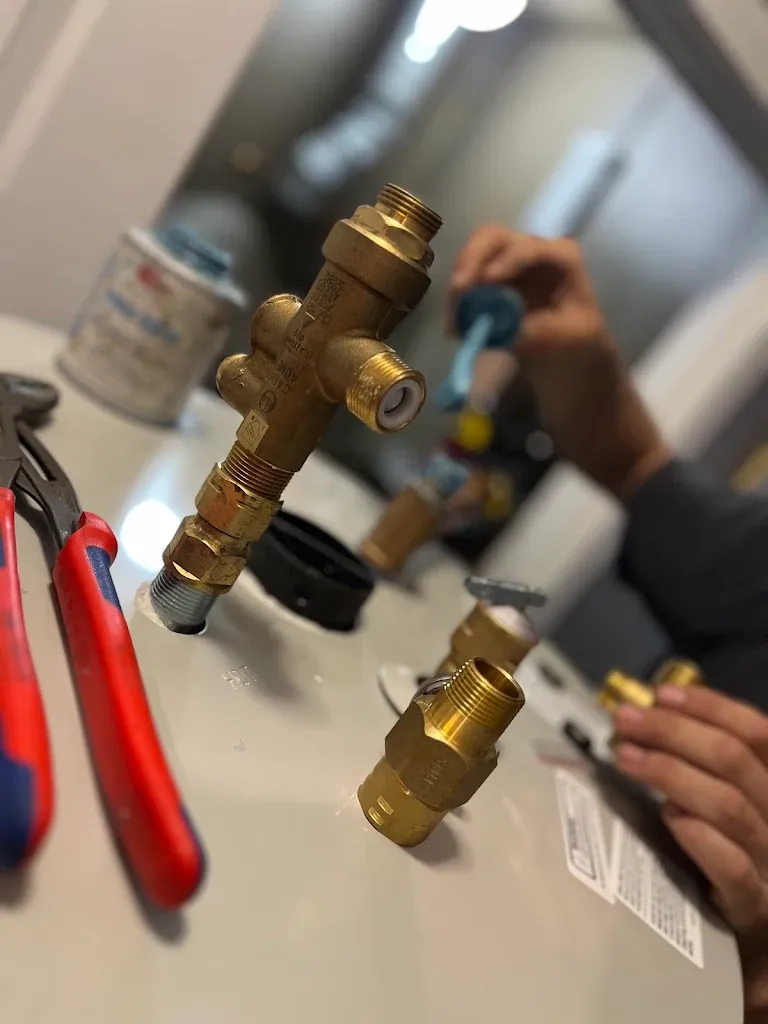
When we retrofit these on an existing heater, the job is typically an hour or two. We shut the water off, drain a little pressure, cut in a tee for the expansion tank on the cold side, install the mixing valve on the hot outlet with unions so it can be serviced, and pressure test everything before relighting. You get a flat price for the whole thing before we pick up a wrench, and the parts carry our warranty along with the manufacturer's.
Signs you need thermal expansion tanks & mixing valves
Call if you notice
- The T&P relief valve drips into the pan after every shower
- You replaced the relief valve and the new one drips too
- Pipes bang or thump when the water heater shuts off
- The hot water runs out well before a second shower finishes
- A home inspector flagged a missing or waterlogged expansion tank
- The expansion tank is rusting at the connection or hanging unsupported
- Hot water at the tap is hot enough to scald within seconds
- A new pressure reducing valve or backflow device was recently installed
- Your water heater is in a closet with no pan and no visible expansion tank
How a thermal expansion tanks & mixing valves call goes
Measure before we recommend
A gauge on the drain valve or a hose bib shows static pressure and the spike during a heating cycle. If a tank is present, we test its air charge and check its mounting.
Pick the right size and set the charge
The expansion tank is sized to the heater and the house pressure, then its air cushion is set with a pump and gauge to match the home before it goes on.
Install with support and unions
The tank is tied into the cold supply near the heater and strapped or bracketed so its weight is carried. Mixing valves go on the hot outlet with unions for future service.
Set the temperature with a thermometer
The tank thermostat is raised for storage, and the mixing valve is tuned so water leaving the heater and water at the farthest fixture read the safe temperature you asked for.
Test and explain
We run a full heating cycle on the gauge to prove the spike is gone, check the relief valve, and show you how to tap-test the tank yourself in a year or two.
Questions we get about thermal expansion tanks & mixing valves
Do I need an expansion tank on my water heater in Washington?
If your home has a pressure reducing valve, a backflow preventer, or a meter with a check valve, your plumbing is a closed system and the state plumbing code calls for one. Most homes on municipal water in Kitsap and Pierce counties fall into that category. Well homes with a pressure tank often do not need a separate one.
Why is my relief valve dripping if the heater is new?
A new heater without an expansion tank, or with one that was not charged to the house pressure, still spikes pressure every time it heats. The relief valve is opening to protect the tank. Fix the expansion, and the valve usually stops on its own.
Can I just turn my water heater down instead of adding a mixing valve?
You can, and many people do. The tradeoff is less usable hot water and a tank temperature that may allow bacteria to grow. A mixing valve lets you keep the tank hot and the taps safe at the same time, which is why we recommend it for families and rentals.
Will a mixing valve really give me more hot water?
Yes, noticeably. Storing water hotter means each gallon is blended with more cold at the fixture, so the tank effectively holds more usable hot water. It is the cheapest way to get a bigger shower out of the heater you already own.
Can you add these to a tankless water heater?
Expansion tanks are smaller on tankless units but still required in a closed system, and we install them with every Rinnai. Mixing valves are less common on tankless because the unit controls outlet temperature itself, but there are situations, like a recirculation loop, where one still makes sense.
What does this cost?
Adding an expansion tank to an existing heater is a modest service call. A mixing valve retrofit is similar, and doing both together saves you a trip charge. Done as part of a heater replacement, they are included in the installation price we quote.