Washington Plumbing & Drain diagnoses and repairs pressure problems across Kitsap, Pierce and Mason counties: failed pressure reducing valves in Silverdale and Gig Harbor tract homes, galvanized pipe in Bremerton and Port Orchard ramblers, long service lines on rural lots in Belfair and Olalla, and hilltop houses where the municipal main simply does not push hard enough to get up the driveway. We put a gauge on the system before we recommend anything.
The repairs range from a new regulator to a booster pump to a repipe, and the honest answer is sometimes none of the above. More than one homeowner has called us after being told they needed a whole new system, and we found a clogged aerator or a half-closed valve. We fix what is actually wrong.
Low pressure everywhere versus low pressure in one place
When every fixture in the house is weak, the problem is upstream of all of them: the service line, the main valve, the pressure reducing valve, the pressure tank on a well, or the supply itself. When only the shower or only the kitchen is weak, the problem is local: a cartridge packed with grit, a clogged aerator, a kinked supply line, a fixture stop that is not fully open, or a single branch of galvanized pipe that has rusted shut while the rest of the house is copper.
Hot-only low pressure points at the water heater. Sediment in a tank heater, a failing dip tube, or a plugged inlet screen on a tankless unit will all cut the hot side while the cold runs fine. A heat trap nipple that has collapsed does the same thing. We check the hot and cold sides separately at the same fixture before deciding where to look.
Pressure that drops when a second fixture opens, so the shower dies when the toilet is flushed, usually means flow restriction rather than low supply pressure. The classic cause around here is a galvanized service line or galvanized trunk lines inside the house, narrowed by decades of rust. The photo at the top of this page shows a section of that pipe from a South Kitsap crawlspace next to the PEX that replaced it.
Pressure reducing valves: what they do and how they fail
Municipal water in parts of Kitsap and Pierce County arrives at the house well above what fixtures are designed for, especially at the bottom of a hill where the main has a lot of elevation behind it. The pressure reducing valve, a bell-shaped brass fitting near the main shutoff, knocks that down to a safe fifty to seventy pounds. It is required on new construction where street pressure is high, and most homes built since the 1980s in Silverdale, Gig Harbor North, Puyallup and University Place have one.
A PRV has a spring, a diaphragm and a seat, and all three wear. When the diaphragm fails the valve usually drifts high, so pressure in the house creeps up until the relief valve on the water heater drips, faucets hammer, and toilet fill valves hiss. When the seat clogs with debris or the spring weakens, the valve starves the house and pressure drops. Both failures feel like a mystery because the valve looks fine from outside.
We test a PRV with a gauge on a hose bib: static pressure with nothing running, then pressure with a couple of fixtures open. A good valve holds within a few pounds. A bad one swings widely or sits outside its range. Replacement is usually a couple of hours, and we match the new valve's size and range to the house and set it with a gauge rather than leaving the factory setting.
- Pressure above eighty pounds at the hose bib: PRV likely failed high or missing
- Pressure that climbs overnight and drops when a tap opens: PRV plus a thermal expansion problem
- Pressure that falls off hard when two fixtures run: PRV undersized or clogged, or pipe restriction
- Banging pipes and dripping relief valve: high pressure, check the PRV first
High water pressure is the problem people do not know they have
Low pressure is annoying. High pressure is destructive. Anything much above eighty pounds shortens the life of every washer, cartridge, supply hose and appliance solenoid in the house, and it is the hidden reason some homes go through faucets and fill valves every couple of years. Dishwasher and washing machine hoses burst under it. Water heaters flex with every cycle. The relief valve drips and gets blamed.
Hillside and waterfront homes are the usual suspects. A house at the bottom of a long grade in Manchester, Ruston or along the Bremerton waterfront can see street pressure well over a hundred pounds. The fix is a correctly sized PRV at the entry, set to a sensible number, paired with an expansion tank on the water heater so the now-closed system has somewhere to put thermal expansion. We check for both on every pressure call.
When the house needs more pressure than the supply gives
Some homes are simply at a disadvantage. A house at the top of a hill above the water district's tank, a cabin at the end of a long two-inch community line in Mason County, a home on a shared well with three other houses, or a property where the service line runs a quarter mile from the meter will all see pressure that no valve can improve. Fixing the pipe does not help because the pipe is not the problem; the water is arriving tired.
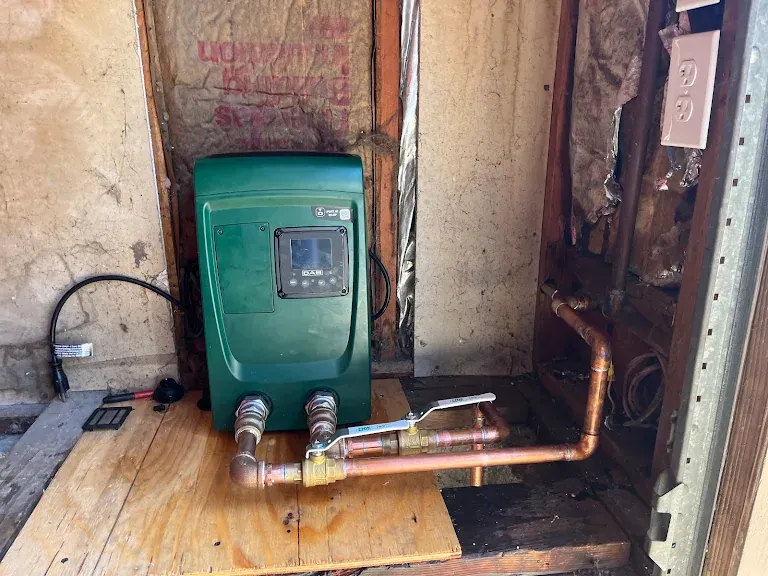
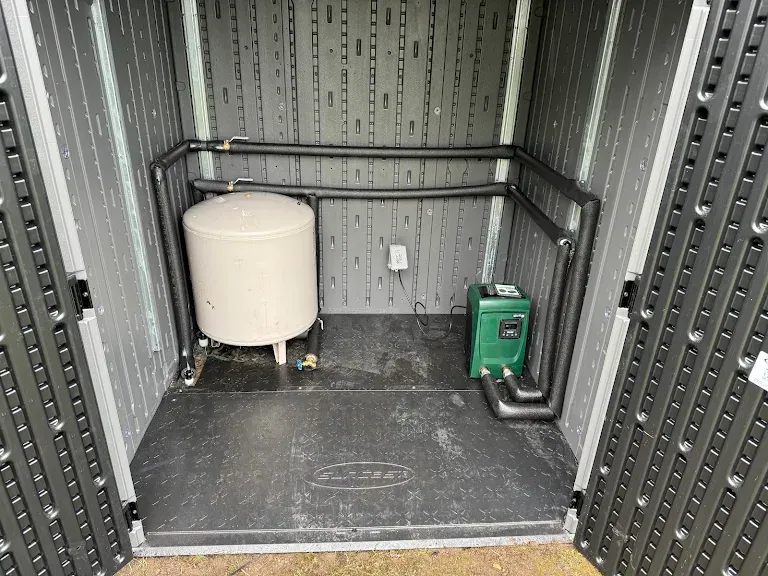
For those homes we install a booster pump. A DAB constant-pressure booster, which is what we install most often, senses demand and ramps to hold a steady set pressure whether one faucet or four are running. It mounts in a utility closet, garage or a small insulated shed near the entry, plumbed in copper with isolation valves on both sides so it can be serviced without draining the house. The photos on this page show two of them, one in a closet and one in a weatherproof shed on a rural lot.
A booster is not the first answer, and we say so when a homeowner asks for one. If the gauge shows decent static pressure and the real issue is a choked pipe, a booster just pushes harder against the same restriction. The gauge and the flow test decide, and we walk you through what they showed before recommending anything.
What we check before we quote a repair
A pressure call starts at the hose bib with a gauge, then at the water heater, then at the farthest fixture, each with nothing running and again with fixtures open. We look at the main valve to confirm it is fully open, because a gate valve that was closed partway during some past repair is a surprisingly common cause. We look at the pipe material at the entry and under the house. On a well we read the pressure switch setting and the tank charge.
That half hour of measuring is what separates a real diagnosis from a guess. By the end of it we can tell you whether the fix is a new PRV, a cleaned-out fixture, a section of galvanized pipe, a booster, a well tank adjustment, or a repipe, and we quote that one thing at a flat rate. If the problem is on the utility's side of the meter, we tell you that too and point you to who to call.
Signs you need low water pressure & pressure regulator repair
Call if you notice
- The shower slows to a drizzle when the washer or toilet runs
- Pressure has faded slowly over several years
- Every fixture in the house is weak, not just one
- Only the hot side is weak at a faucet or shower
- Faucets and toilet fill valves hiss, bang or fail every year or two
- The water heater relief valve drips and pipes thump when a tap closes
- Pressure is fine at the hose bib but weak on the second floor
- The house sits at the top of a hill or the end of a long line
- A gauge on the hose bib reads under forty or over eighty pounds
How a low water pressure & pressure regulator repair call goes
Gauge the system
Pressure readings at the hose bib, water heater and farthest fixture, static and under flow. Hot and cold are tested separately so a water heater problem is not mistaken for a supply problem.
Check the obvious
Main valve fully open, fixture stops open, aerators and cartridges clean, PRV range and setting. A surprising share of pressure calls end here with a small fix.
Find the restriction or the shortfall
Pipe material at the entry and in the crawlspace, service line length and route, well pressure switch and tank charge, and the elevation between the supply and the house.
One flat price for the real fix
A PRV replacement, a fixture repair, a section of pipe, a booster pump sized to the house, or a repipe when the pipe is the problem. You see the gauge readings that led to the recommendation.
Set it and prove it
The new PRV or booster is set with a gauge, the system is run with multiple fixtures open, and you watch the numbers before we leave.
Questions we get about low water pressure & pressure regulator repair
What should my water pressure be?
Somewhere between fifty and seventy pounds at the hose bib is comfortable for most homes. Under forty feels weak upstairs. Over eighty is hard on fixtures and appliances and is where the code wants a pressure reducing valve. A simple gauge that threads onto a hose bib will tell you in seconds.
Why is my water pressure low only in the shower?
Usually the shower valve cartridge or the showerhead. Grit and scale collect in both, and a cartridge that has partially plugged cuts flow while the sink next to it runs fine. If the shower is fed by an old galvanized branch while the rest of the house is copper, that branch may be the restriction.
How do I know if my pressure reducing valve is bad?
Put a gauge on a hose bib. If it reads far above or below the valve's setting, or swings widely when fixtures open and close, the PRV is failing. A relief valve dripping on the water heater and banging pipes are the common symptoms of one that has failed high.
Can high water pressure really damage my plumbing?
Yes, steadily. Every cartridge, washer, supply hose and appliance valve is rated for a range, and sustained pressure above it wears them out early and can burst a washing machine hose. A failed PRV is one of the most common reasons a house goes through faucets and fill valves every couple of years.
Will a booster pump fix my low pressure?
If the supply is weak because of elevation, a long line, or a shared system, yes. If pressure is weak because of rusted pipe, a booster pushes harder against the same clog and does little. We gauge and flow-test before recommending one, and we tell you if the answer is a repipe instead.
Does the water utility fix low pressure?
Only up to the meter. If pressure at the meter is low, Kitsap PUD, West Sound Utility District, the City of Bremerton and the other local suppliers will look at their side. Everything from the meter into the house is the homeowner's, and that is where most pressure problems live.
My well has low pressure. Is that a plumbing problem?
Often it is the pressure switch setting, a waterlogged tank, or a worn pump rather than the house plumbing. We service all three. If the well simply cannot deliver enough, a larger tank or a booster downstream of it can help, and we size either to the house.