
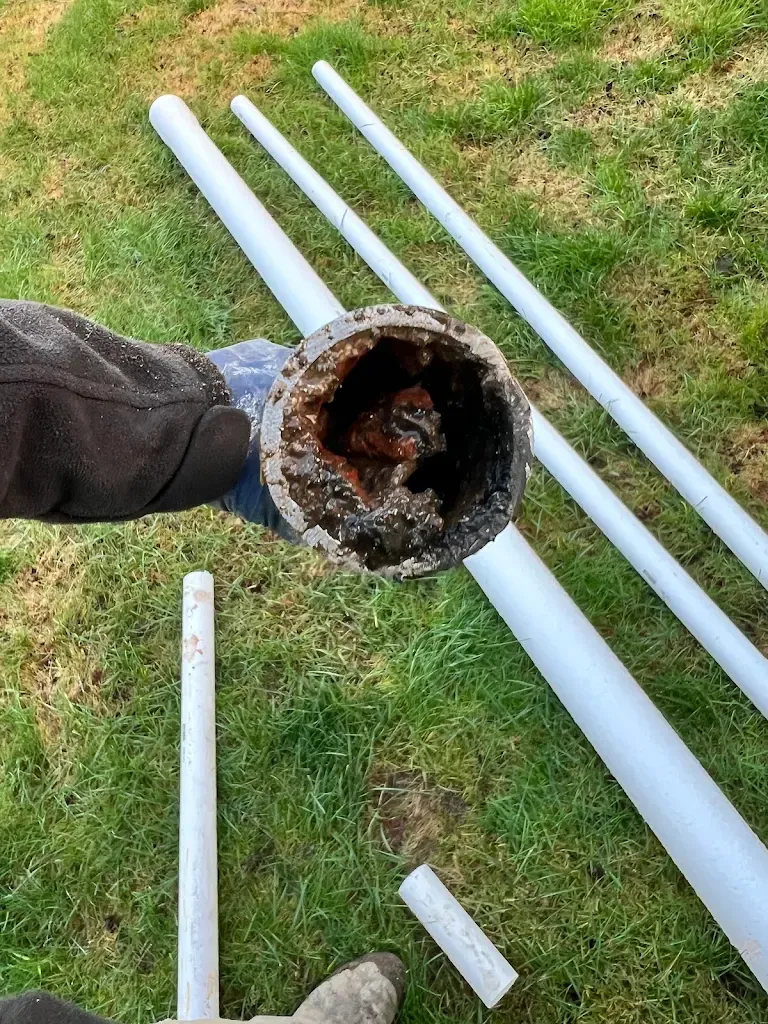
Cast iron drains fail in a different way but on the same schedule. The bottom of the pipe, where water sits, corrodes thin while the top looks fine. Scale builds inside until the pipe holds half its original flow. Then a joint lets go in the crawlspace or a hairline split opens under a slab, and the first sign is a smell or a soft spot in the floor.
Washington Plumbing & Drain replaces both kinds of pipe throughout Kitsap, Pierce and Mason counties, in sections where one run has failed and whole-house when the system has reached the end. We work in crawlspaces, basements, garages and open walls, and we show you what came out.
Which homes have these pipes
The big wave of construction around the Puget Sound Naval Shipyard, the Bremerton annex neighborhoods, Manette, Charleston, downtown Port Orchard, Tacoma's older grid and the first Gig Harbor subdivisions ran from the 1940s through the early 1970s. Galvanized steel was the standard water pipe and cast iron the standard drain for most of that period. Copper water lines took over gradually in the 1960s, and plastic drains in the 1970s.
That means a home from that era can have any combination: galvanized supply and cast iron drains, copper supply and cast iron drains, or a partial repipe where someone replaced the accessible runs and left the rest. Older Mason County cabins and farmhouses sometimes have galvanized well lines still in the ground. A quick look in the crawlspace or at the water heater connections usually tells us which you have.
What happens to galvanized water pipe
Galvanized pipe is steel with a zinc coating. The zinc wears off from the inside first, and once bare steel meets water the rust begins. Rust is bulkier than the steel it replaces, so it grows inward, narrowing the pipe and leaving a rough surface that collects sediment. Hot water lines go first because heat speeds the reaction, which is why the hot side in an old house is often worse than the cold.
The symptoms arrive in a predictable order. Pressure drops at the fixture farthest from the main, then at the second floor, then everywhere. Water runs rusty after it sits. Threaded joints weep where the threads have thinned. Eventually a pinhole opens, usually on a hot line, usually in a wall or ceiling. A galvanized line that is leaking in one place is thin everywhere, and patching it is throwing good money after bad.
The replacement is PEX in most cases, run in a crawlspace or attic with a manifold or trunk-and-branch layout, or copper where a homeowner prefers it or where the pipe will be exposed. Either way the pressure comes back the day the new pipe is turned on.
What happens to cast iron drains
Cast iron is thick and heavy, and the horizontal runs under a house rust along the bottom where waste sits between uses. Vertical stacks fare better. Inside, a crust of scale forms that catches hair and paper, and the pipe clogs more often each year. A cable cleaning scrapes that scale and can open a thin section further. Hydro jetting with a chain nozzle cleans it properly but cannot restore metal that is gone.
The failures look like a sewage smell in the crawlspace that comes and goes, a damp patch on a basement wall below a drain, a hollow sound or soft spot in a bathroom floor, or a camera inspection that shows a split or a channel worn along the bottom. Once one section is that far gone, the rest of the horizontal run is usually close behind.
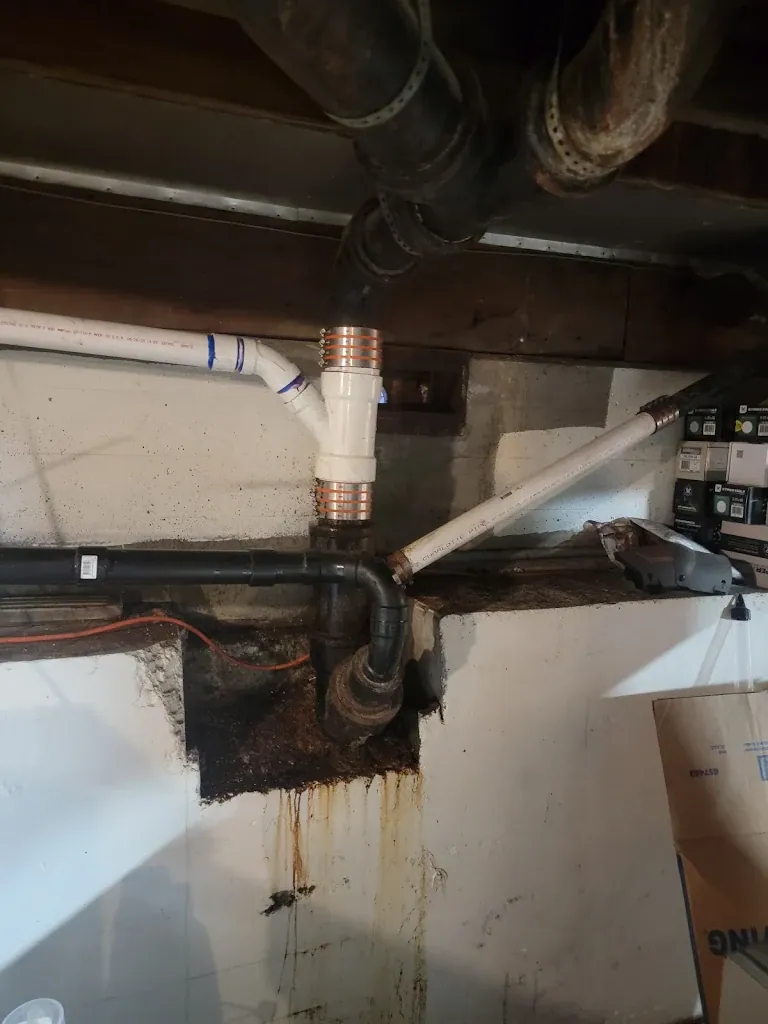
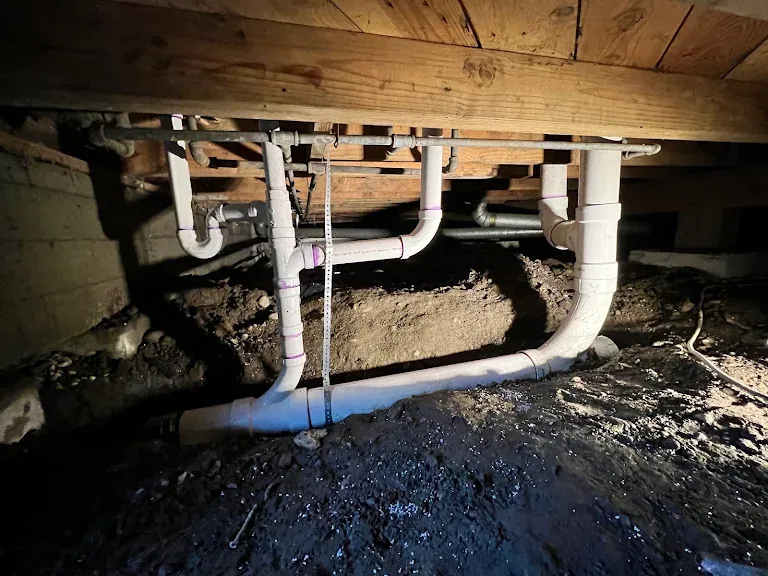
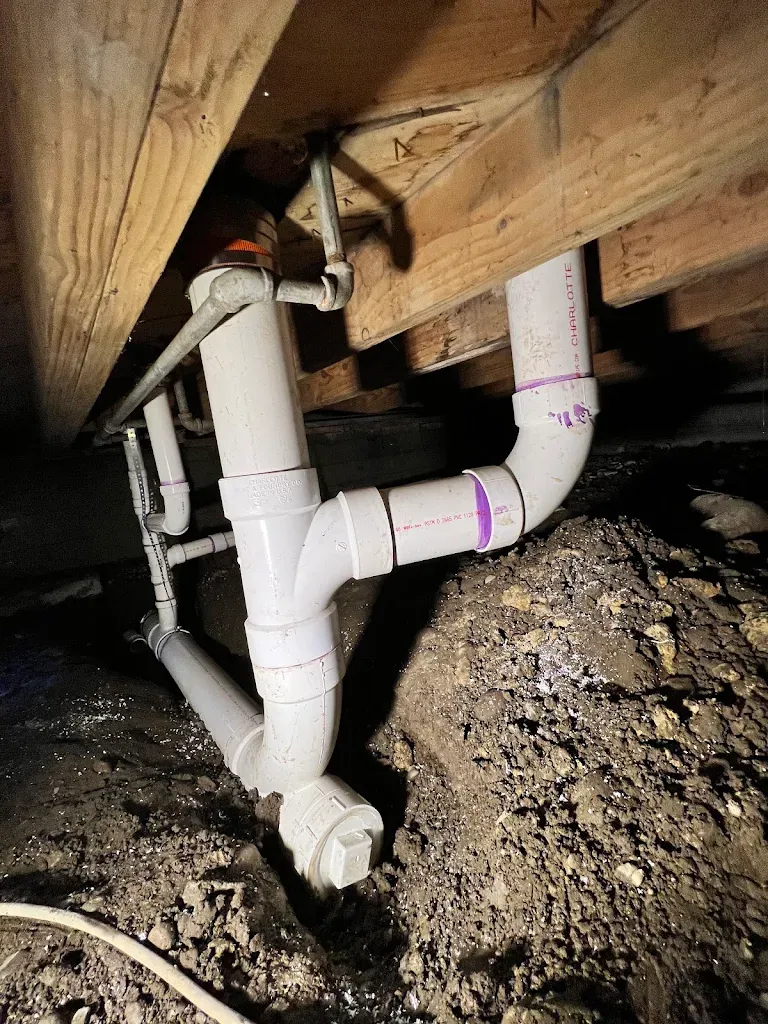
We replace cast iron with PVC or ABS, hung at proper slope with the correct hangers and transitioned to any remaining iron with shielded couplings. Where the iron runs under a slab we open the floor, replace the run, and patch the concrete. A cleanout is added at every reasonable point.
- PVC or ABS drains, sloped and strapped to the joists
- Shielded transition couplings at every iron-to-plastic joint
- Cleanouts at stack bases and the building drain exit
- Proper venting corrected where the old system was short
- Floor and wall patching coordinated or referred as needed
Sectional replacement versus a full repipe
A single failed run can be replaced on its own, and we often do that: the kitchen drain in the crawlspace, the main stack from the basement floor to the attic, the hot line to a bathroom. That keeps the cost in the hundreds to low four figures and gets a specific problem solved. We will tell you plainly if what we see suggests the rest of the system is close to the same point.
A full drain replacement or whole-house water repipe is the better value when more than one run has failed, when a remodel is opening walls anyway, or when you plan to keep the house for years. Doing it once means one permit, one set of patches, and no more surprise calls. We walk the house with you, map what is there, and quote both approaches so the decision is yours.
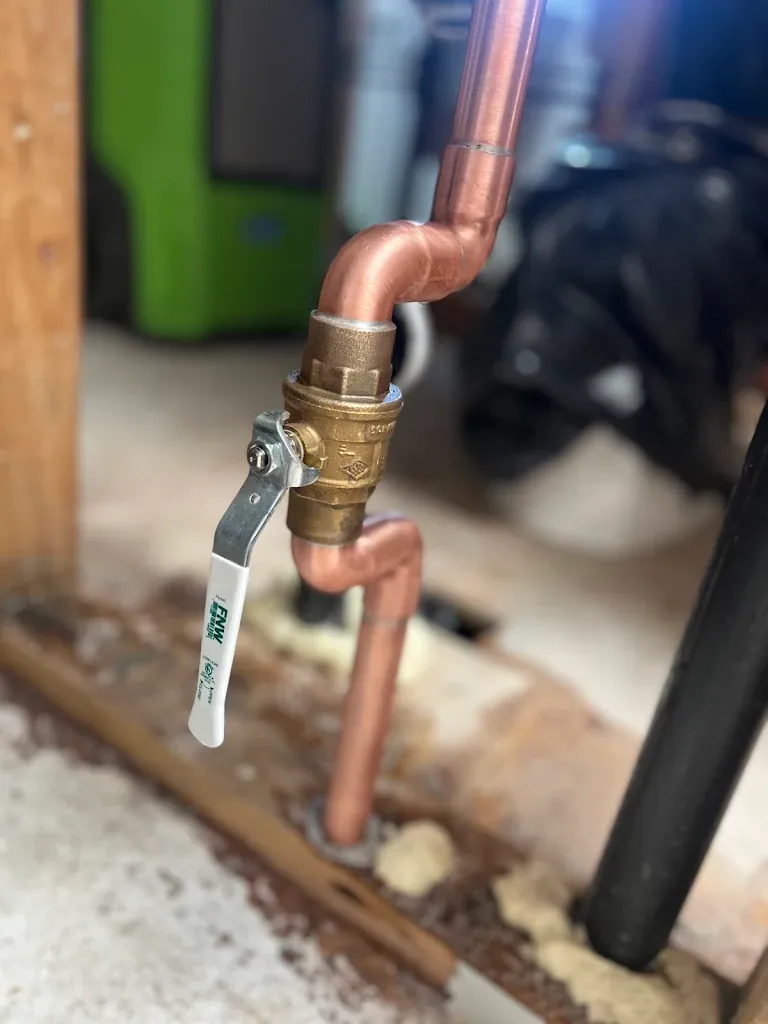
Working in Kitsap and Pierce County crawlspaces
Most of this work happens on our backs in a crawlspace. The older homes near the water have low, damp crawlspaces with a high water table in the rainy months, and the cast iron down there has often been sitting in wet soil for decades. We bring lighting, pumps where needed, and the patience to do it right in a space where nothing is easy.
Where a house has a basement, which is more common in the hillier Tacoma and Bremerton neighborhoods, the drain work is faster and the transitions are visible. Either way you get photos of the old pipe, the new pipe, and every coupling before anything is closed up.
Pricing, permits and what to expect
Sectional replacement is quoted after we look at the run and the access, and you approve the price on your phone. A full drain replacement or water repipe is a multi-day project with a written estimate, a permit and an inspection, and we schedule it around your household so water and drains are down for the shortest possible time. Water is usually off only for part of a day at the changeover.
If an insurance claim is involved, as it often is when a cast iron drain has leaked under a floor, we document the failure and the repair in a way your adjuster can use.
Signs you need cast iron & galvanized pipe replacement
Call if you notice
- Water pressure has dropped slowly over years, worst at the farthest fixture
- Water runs brown or rusty after sitting overnight or after a vacation
- The hot side has noticeably less pressure than the cold
- A sewage smell in the crawlspace or basement that comes and goes
- A damp patch or rust stain on a basement wall or crawlspace soil below a drain
- Drains clog more every year despite cleaning
- A camera showed heavy scale, a channel along the bottom, or a split in the drain
- Threaded joints on the water pipe are weeping or caked in rust
- The home was built before 1970 and the pipes have never been replaced
How a cast iron & galvanized pipe replacement call goes
Look at what is there
We walk the crawlspace, basement, garage and fixture connections, identify the pipe materials and note where the original runs were already replaced. A camera goes into the drains if their condition is in question.
Map the options
You get a written quote for replacing the failed run and, where it makes sense, a quote for the full drain or supply replacement, with the reasoning for each. Approve on your phone whenever you are ready.
Permit and schedule
A permit is pulled for repipe work, and the job is scheduled so water and drains are out of service for the shortest stretch possible.
Replace and transition
Old pipe comes out, new PVC or ABS drains and PEX or copper supply go in at proper slope and support, with shielded couplings at any remaining iron and cleanouts added.
Test and inspect
Drains are water-tested and supply lines are pressure-tested before the inspector signs off and walls or floors are closed.
Show you the pipe
You get photos of the old pipe, the new runs and every transition, and we leave the worst section of the old pipe for you to see if you want it.
Questions we get about cast iron & galvanized pipe replacement
How do I know if I have galvanized or cast iron pipe?
Galvanized water pipe is gray, threaded at the joints and rings dull when tapped; a magnet sticks to it. Cast iron drains are black or rusty, thick-walled, with hub joints or no-hub bands, and are usually 3 or 4 inches across. Look near the water heater, under sinks and in the crawlspace.
Can galvanized pipe be cleaned out instead of replaced?
No. The rust is part of the pipe wall, and there is no way to remove it without removing the metal. A galvanized line that has narrowed is replaced, not cleaned.
Can cast iron drains be repaired instead of replaced?
A single bad joint or a short split can be cut out and replaced with plastic and shielded couplings, and we do that often. But cast iron that has failed in one place is thin in others, so we camera the rest and tell you what to expect.
Do you replace cast iron with PVC or ABS?
Either, depending on what the rest of the house uses and what the inspector in your jurisdiction prefers. Both are approved drain materials. We do not mix them in the same run without the proper transition cement and fittings.
Will replacing my galvanized pipe fix my water pressure?
If the pressure drop is from narrowed pipe, yes, immediately and dramatically. If the pressure is also low at the meter or you are on a well with a tired pump, we tell you that during the assessment so you are not expecting a repipe to fix something else.
How long does a whole-house drain or supply replacement take?
A water repipe in PEX is commonly two to three days for an average house, with water off only during the changeover. A full drain replacement under a house varies with access and can run a few days to a week. Sectional jobs are usually a single day.
Does replacing old pipe require a permit?
Yes for repipes and drain replacement in Washington. We pull the permit, schedule the inspection, and include the records with your paperwork.
Will this help with an insurance claim for water damage?
We document the failed pipe and the repair with photos and a written description that adjusters understand. Restoration of the damaged materials is a separate company's work, and we can point you to one.