Short answer
Summer is when winter's damage shows up and when wells, irrigation and outdoor water get their hardest use. Turn each hose bib on and watch the wall behind it, start irrigation zone by zone, get the backflow assembly tested if your water district requires it, and listen to the well pump during the dry weeks of August. It is also the easiest season to do the water heater and crawlspace work that is miserable in the rain.
In this guide
- Start with the hose bibs, with someone watching inside
- Irrigation startup done in order
- Backflow testing and why your water district sends that letter
- Wells and pressure tanks under summer load
- Outdoor drains, yard hydrants and the things that grow into pipes
- Water heater housekeeping while the weather is good
- Dry-weather projects that are miserable in winter
Key takeaways
- A hose bib that froze in January often does not show the split until the first time it runs under pressure in May. Test every bib with the hose off and someone watching inside.
- Irrigation backflow assemblies on Kitsap PUD, City of Port Orchard, Silverdale Water and most other districts need annual testing by a certified tester.
- Wells work hardest in August. A pump that short cycles or a tank that has lost its air charge will fail under summer lawn watering before it fails in winter.
- Dry weather is the right time for crawlspace repipes, sewer line excavation and water line replacement.
- Water heaters still need their annual flush in summer, and tankless units in well-water homes need descaling on schedule regardless of season.
Start with the hose bibs, with someone watching inside
Most freeze damage to outdoor faucets is invisible from outside. A frost-free hose bib has its valve seat deep inside the wall, and when it freezes with a hose attached the barrel splits somewhere between the handle and the seat. The bib looks fine. It even shuts off fine. But when you open it, water sprays out of the split inside the wall while the hose end runs normally, and you never see it until the drywall in the garage or the subfloor under the kitchen is soaked.
So the first summer job is a two-person test. One person turns on each bib with no hose attached while the other stands inside at the wall behind it, or in the crawlspace below it, listening and looking for water. Run each bib for a full minute. Then attach a hose with a shutoff nozzle, close the nozzle so the bib is under full pressure, and check again. A split that only leaks under pressure shows up in that second test.
A bib that drips from the handle when running usually needs a new packing or a cartridge, which is a quick fix. One that leaks inside the wall needs to be replaced, and this is the time to replace a plain sill cock with a frost-free model so it does not happen again.
Irrigation startup done in order
Bringing an irrigation system online after a winter shutdown should be slow and deliberate. Open the main irrigation valve only partway at first so the lines fill without hammering. Air rushing ahead of the water can blow heads off and crack fittings if the valve is opened all at once. Then run each zone from the controller and walk it: look for geysers from broken heads, soggy spots that point to a cracked lateral, and heads that do not pop up.
The controller itself usually needs attention. Batteries die, schedules get wiped by winter power outages, and the rain sensor on the eave has often filled with needles. Set the schedule for early morning so the lawn dries before evening and the system is not competing with showers for pressure.
If the house is on a well, irrigation is the thing most likely to overwork the pump. A zone that pulls more than the well can deliver will drop the pressure for the whole house and can run the pump dry on a low-yield well in August. Smaller zones, longer run times and a cycle-and-soak schedule are easier on the well than a few big zones running back to back.
- Open the irrigation main slowly to fill lines without water hammer
- Run each zone and walk it looking for broken heads and leaking laterals
- Replace controller batteries and reset the schedule for early morning
- Clean or replace the rain sensor
- On wells, keep zones small so the pump is not overdrawn
Backflow testing and why your water district sends that letter
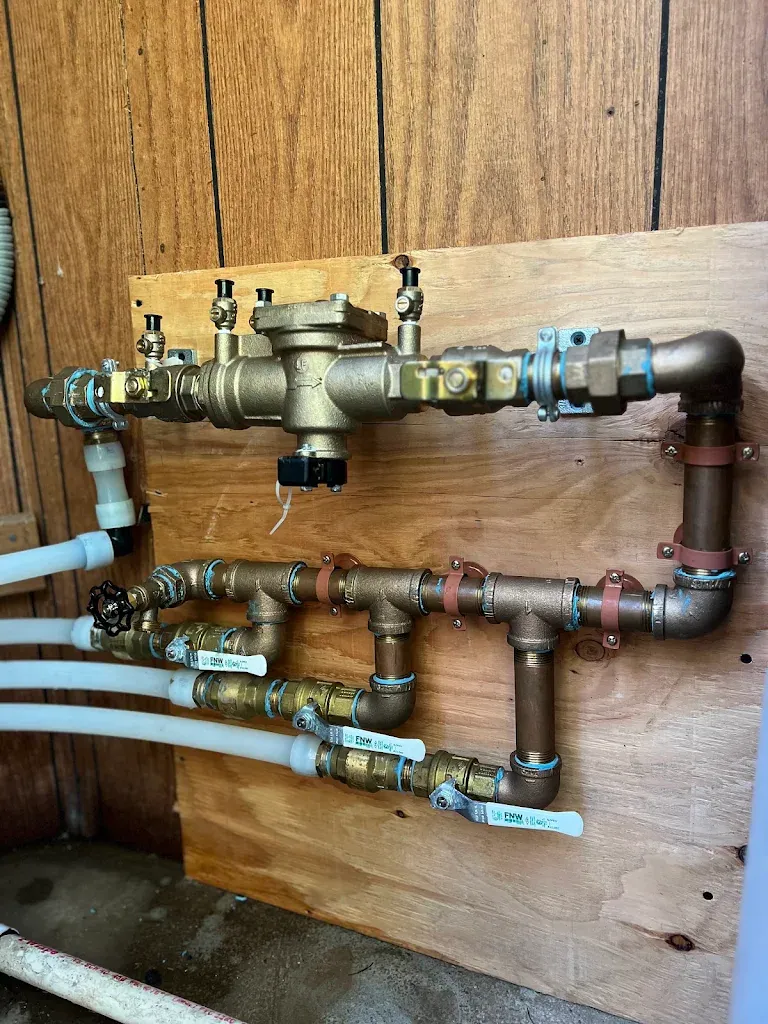
If your irrigation system is connected to public water, there is a backflow preventer between the house supply and the sprinkler lines. Its job is to keep fertilizer, soil bacteria and whatever is sitting in the sprinkler lines from being siphoned back into the drinking water if pressure drops in the street. Washington water purveyors are required to make sure these assemblies work, which is why Kitsap PUD, West Sound Utility District, Silverdale Water, the City of Bremerton and the rest send an annual testing notice.
The test has to be done by a certified Backflow Assembly Tester, and the results go to the district. If the assembly fails, it gets repaired or replaced and retested. The most common failures we see are relief valves that stuck over winter, check valves fouled with debris, and assemblies that cracked when they froze because nobody insulated them in December.
If you are installing new irrigation or adding a hose bib to a well-and-city dual system, the backflow device has to be sized and installed to the district's standard, and we handle that along with the piping.
Wells and pressure tanks under summer load
Private wells in Mason County, South Kitsap and the Key Peninsula get their heaviest workout between July and September. Lawns, gardens, kids in the sprinkler and a house full of summer guests all pull from a well that may already be at its seasonal low. This is when a tired pump or a waterlogged pressure tank gives out.
Listen to the system. A pump that turns on and off every few seconds while a hose runs has a pressure tank that lost its air charge, and that short cycling will burn out the pump motor and the pressure switch contacts. A pump that runs for a long time and delivers weak flow may be pulling from a well that is drawing down, or it may be a worn impeller. Pressure that climbs slowly and then suddenly drops is often a leak in the drop pipe or a failing check valve.
Check the pressure tank air charge with the pump off and the tank drained. The air pressure should be a couple of pounds below the pressure switch cut-in setting. If the tank is waterlogged and will not hold a charge, the bladder has failed, and it needs to be replaced with a properly sized Well-X-Trol or Amtrol tank.
Outdoor drains, yard hydrants and the things that grow into pipes
Summer growth is when roots do their work. A sewer line that was cleared of roots in February will have new growth by August, and a yard with a big maple or a row of cedars over the sewer run should have the line on camera every year or two. Dry weather is also when a bellied or broken sewer section is easiest to excavate and replace, since the trench is not filling with groundwater.
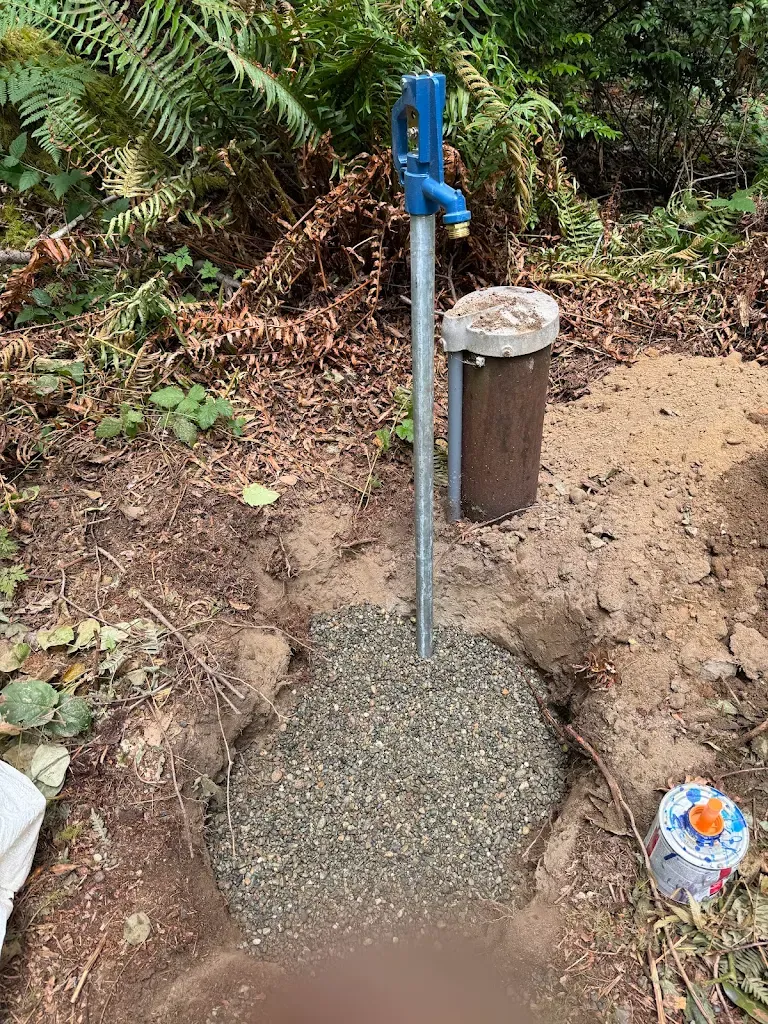
Yard hydrants on rural properties should be checked for drainage. A frost-proof hydrant drains the standpipe into a gravel bed when closed, and if that drain port plugs with silt, the hydrant will freeze next winter. Open it, let it run, close it and watch that water stops coming out of the spout within a few seconds.
Outdoor kitchens, hot tubs and RV hookups all count as plumbing. A hose bib feeding an RV for weeks at a time is a place to watch for a slow drip, and any outdoor connection with a hose left on under pressure all summer is also a connection with a hose left on when the first freeze arrives in November.
Water heater housekeeping while the weather is good
A tank water heater should be drained of sediment once a year, and summer is the easiest time to do it. Sediment builds up faster in well-water homes and in the parts of Kitsap with higher mineral content, and a tank with a few inches of sediment pops and rumbles, heats slowly and fails early. While the tank is being flushed, the anode rod should be checked, because a used-up anode is the start of a rusting tank.
Tankless water heaters on well water need descaling on a schedule, often every year, and a unit that has not been descaled will begin to throw error codes or lose flow in the hottest weeks when demand is highest. Rinnai and similar units have isolation valves for this if they were installed correctly, and if they were not, adding them makes every future service faster.
Summer is also a good time to replace a water heater that is at the end of its life, before it fails on a December evening when every plumber in the county is working freeze damage. A tank that is more than ten or twelve years old, shows rust at the base, or has a relief valve that drips is one to deal with now.
Dry-weather projects that are miserable in winter
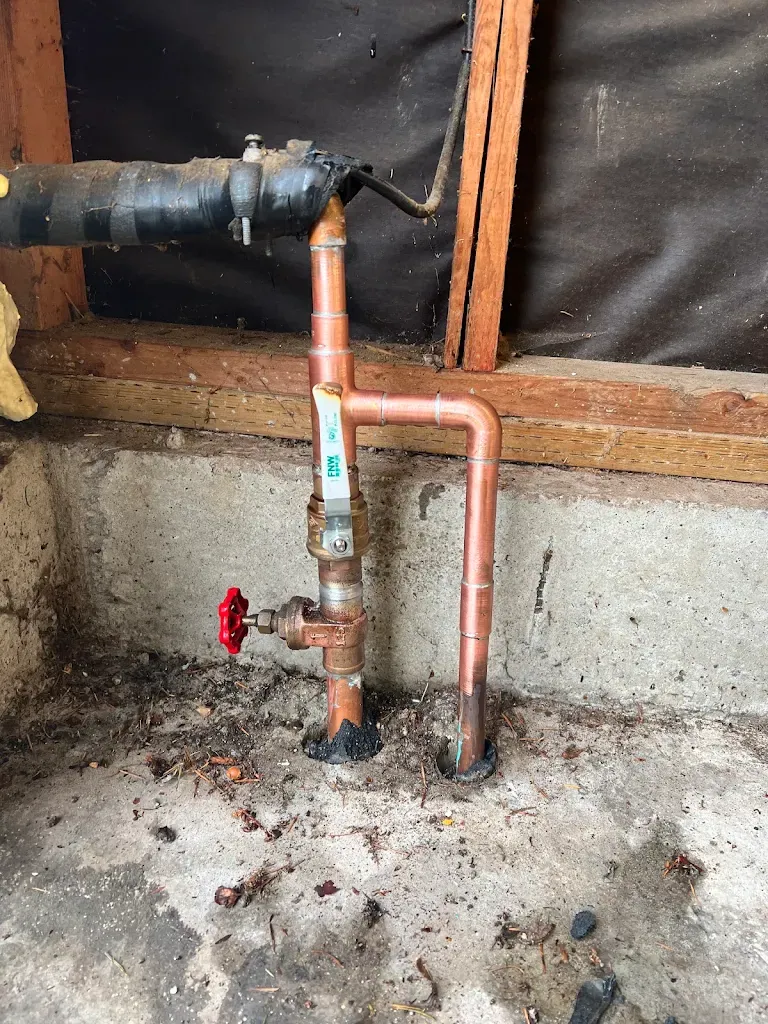
Crawlspace work in August is dusty. Crawlspace work in January is lying in cold water. If you have a crawlspace repipe, a cast iron drain replacement or a sagging drain line on the list, schedule it for the dry months. The same goes for water service line replacement from the meter to the house, sewer line repairs that require excavation, and adding an exterior cleanout. Every one of those is faster, cleaner and cheaper when the trench stays dry.
Steep waterfront lots and long gravel driveways in Mason County and along Hood Canal are the extreme case. Getting an excavator onto a hillside lot after the rain starts can be impossible until spring, so a sewer line that showed damage on camera in the spring should be repaired by September.
Frequently asked
How do I know if a hose bib split over the winter?
Run it with the hose off while someone watches inside the wall or in the crawlspace below. Then put it under full pressure with a closed hose nozzle and check again. A split frost-free bib leaks inside the wall only when the valve is open or the barrel is pressurized.
Who can test my irrigation backflow preventer?
A certified Backflow Assembly Tester. The test results go to your water district. We test, repair and replace backflow assemblies for irrigation and other uses across Kitsap, Pierce and Mason counties.
My well pressure drops when the sprinklers run. Is the well failing?
Possibly, but more often the pressure tank or pump is undersized for the demand or the tank has lost its air charge. We check the tank, the pressure switch and the pump's performance before anyone talks about the well itself.
Is summer really the best time to replace a water heater?
It is the most convenient time. Demand on plumbers is lighter, parts are easy to get, and a planned replacement lets you choose the heater instead of taking whatever is on the truck. Failures cluster in cold weather when the incoming water is coldest and tanks work hardest.
Can I leave a hose connected to the hose bib all summer?
Yes, as long as the hose comes off before the first freeze. A hose with a closed nozzle left under pressure can also strain the bib's packing and cause a drip at the handle, so shut the bib off at the handle when you are done rather than at the nozzle.
About the author. Gregory Lowe is the owner and lead plumber at Washington Plumbing & Drain, a veteran-owned company in Port Orchard serving Kitsap, Pierce and Mason counties. The guidance here comes from daily work in local homes, not from a content farm. Call (360) 812-1124 with questions.