
Short answer
Size a tank water heater by its first-hour rating, not just its gallons: a one-to-two-person home is usually fine with a 40-gallon tank, three to four people with 50, and five or more with 65 to 80 or a high-recovery gas unit. Size a tankless by the gallons per minute it can heat at the temperature rise your water needs, which in Kitsap, Pierce and Mason counties means a rise of around 70 degrees in winter; a single large gas unit handles one shower and one more fixture at once, and bigger households need a larger unit or two in parallel. Heat pump tanks should be sized a step larger than the standard tank they replace.
In this guide
- Start with how your household uses hot water
- Sizing a tank: first-hour rating, not just gallons
- Sizing a tankless: flow and temperature rise
- The soaking tub problem
- Heat pump water heaters size differently
- Long pipe runs and recirculation
- Physical fit, fuel and the things that limit your choice
- How we size one on a service call
Key takeaways
- First-hour rating, printed on the yellow EnergyGuide label, tells you how much hot water a tank can deliver in a busy hour. Match it to your peak hour, not your daily total.
- Gas tanks recover faster than electric, so a 40-gallon gas tank often does what a 50-gallon electric tank does.
- Our incoming water sits in the forties in winter, so a tankless needs a 70-degree rise and delivers about half its advertised flow.
- A soaking tub is the single fixture most likely to change the size you need. Measure it before buying anything.
- Heat pump water heaters recover slowly in heat pump mode; buy one size up from the tank you are replacing.
- Oversizing a tank wastes energy and space; undersizing a tankless makes every winter shower a gamble. Size each one on its own terms.
Start with how your household uses hot water
Sizing is not about how many bathrooms you have. It is about what happens in your busiest hour. A couple in a three-bath house in Gig Harbor who shower at different times needs less heater than a family of four in a two-bath Bremerton rambler where everyone gets ready between six and seven on a school morning. So count the fixtures that run in that hour. Each shower is roughly two gallons a minute for ten minutes, call it twenty gallons. A bath is thirty to fifty depending on the tub. A dishwasher cycle draws a few gallons of hot water; a washing machine on hot can take fifteen or more.
Add it up for your worst hour. Two back-to-back showers and a load of laundry is roughly fifty-five gallons. Three showers plus the dishwasher is close to seventy. That number is what you will compare against a tank's first-hour rating, and it is what tells us how many fixtures a tankless needs to run at once.
Sizing a tank: first-hour rating, not just gallons
A 50-gallon tank does not deliver fifty gallons of hot water. It delivers something like forty before the mix gets cool, plus whatever it can reheat during the hour. The number that captures both is the first-hour rating, FHR, which is printed on the yellow EnergyGuide label on every new tank. A 50-gallon electric tank might have an FHR in the mid-sixties; a 50-gallon gas tank with a strong burner can be in the eighties because it recovers so much faster.
Pick a tank whose FHR is at or a little above your busiest hour. As a rough map for the three-county area: one or two people, a 40-gallon tank. Three or four, 50 gallons, or 40 gallons in gas. Five or six, 65 to 80 gallons electric or a 50-gallon high-recovery gas unit. More than that, or a big soaking tub, and we are talking about 75 to 80 gallons, two tanks, or a tankless.
A note on electric tanks: most standard residential electric tanks have two elements but only heat with one at a time, which is why their recovery is slow and why they need the larger size. A gas tank's burner reheats the whole tank at once.
- 1–2 people: 40 gallons (30 may do for a single occupant with no tub)
- 3–4 people: 50 gallons electric, 40–50 gallons gas
- 5–6 people: 65–80 gallons electric, 50 gallons high-recovery gas
- Large tub or 7+ people: 75–80 gallons, two tanks, or tankless
Sizing a tankless: flow and temperature rise
A tankless heater has no storage, so the question is how many gallons per minute it can heat to your setpoint while the water is coming in cold. Manufacturers rate units in gallons per minute at a given temperature rise. The rating most people see on the box assumes a rise of around 35 degrees, which describes a Florida winter, not ours. Water from Kitsap and Pierce wells and reservoirs arrives at the heater in the mid-forties to low fifties from November into April. To get 120-degree water you need a rise close to 70 degrees.
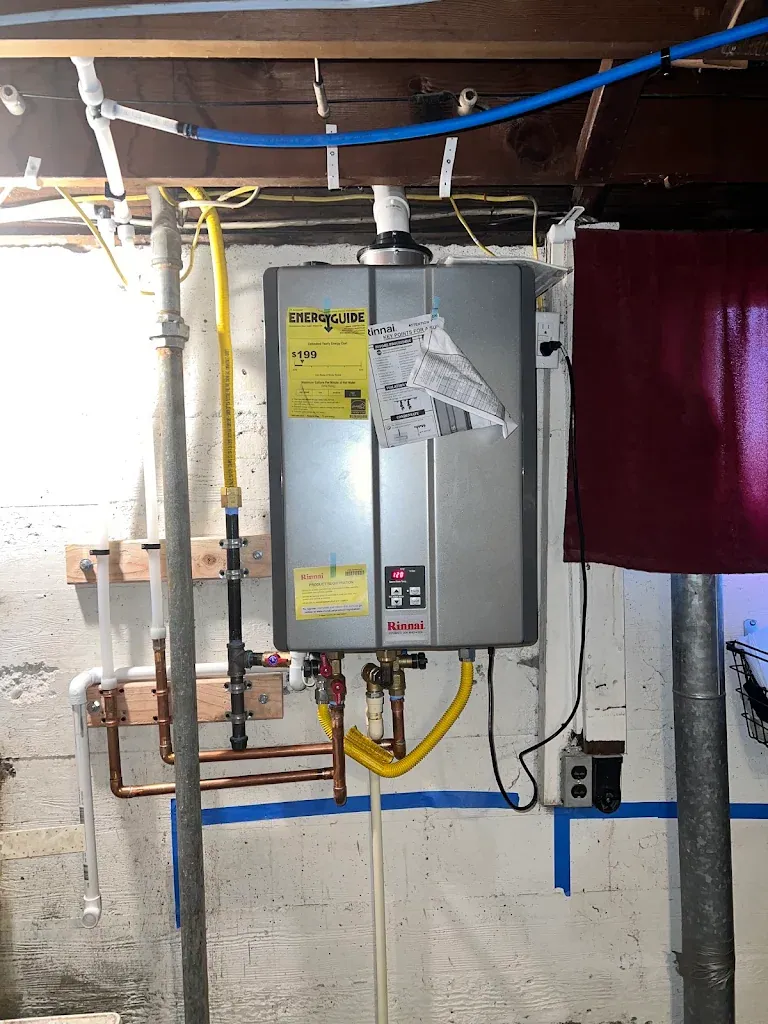
At a 70-degree rise, a large residential gas tankless delivers somewhere in the range of four to five gallons a minute. A modern low-flow shower is about two. A kitchen faucet is one and a half to two. So one big unit comfortably runs one shower and one sink, or two efficient showers, at the same time in January. A household that regularly has two showers and a washing machine going needs either the largest single unit available or two units cascaded, which Rinnai and others support.
Electric tankless is where this gets hard. The electrical draw to produce a 70-degree rise at even three gallons a minute is beyond what most panels in older Navy-era and PUD-served homes can supply. We size electric tankless for point-of-use at a single sink and rarely for a whole house here.
The soaking tub problem
A deep freestanding tub, which shows up in a lot of Silverdale and Gig Harbor North remodels, can hold sixty to eighty gallons. Filling it with a mix of hot and cold still draws forty to fifty gallons of hot water in ten minutes. A 50-gallon tank will do it once, barely, and then recover for an hour. A single tankless will fill it, but slowly, and at a 70-degree rise the fill may take long enough that the water is cooling in the tub before it is full.
Options, in rough order of cost: a larger tank sized to the tub; a tankless paired with a small buffer tank so the first minutes of the fill come from storage; two tankless units; or a dedicated tankless for the tub bathroom. Measure the tub's capacity and tell us about it before we quote the heater, because it changes the answer more than the number of bedrooms does.
Heat pump water heaters size differently
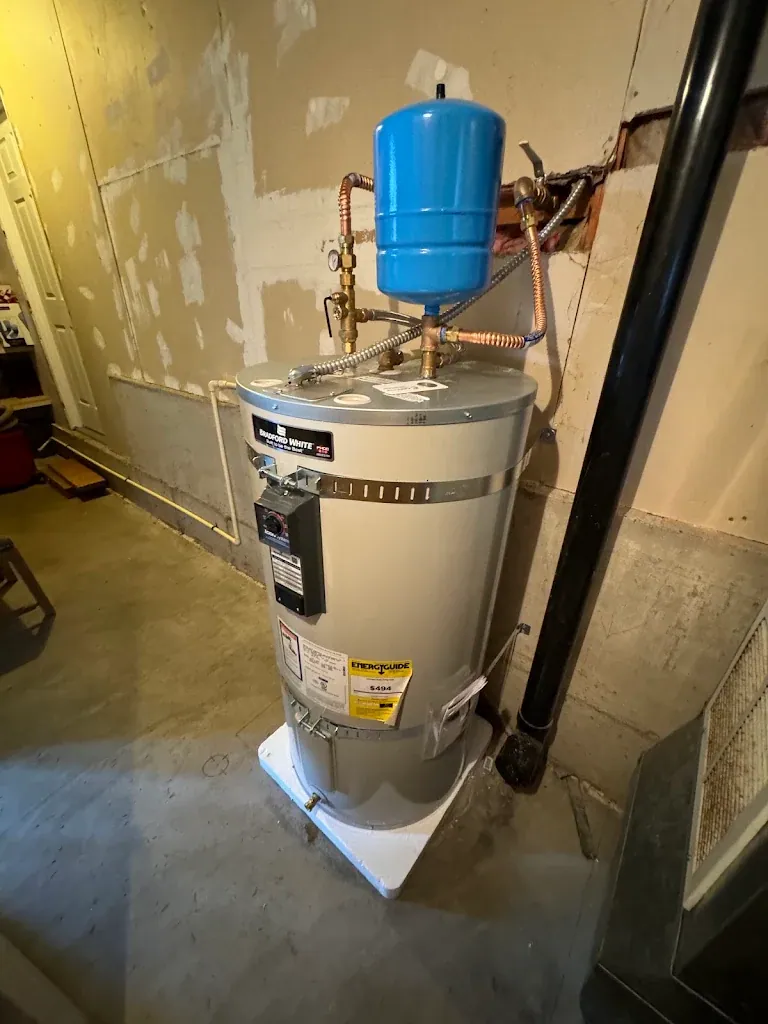
A heat pump water heater pulls heat from the air around it and puts it into the tank. In heat pump mode its recovery is much slower than a gas burner or even a standard electric element. Most hybrids have backup elements that kick in when demand is high, but running on the elements gives up the efficiency you bought it for. The usual advice, and ours, is to go one size up: a home that would use a 50-gallon standard electric tank should get a 65- or 80-gallon heat pump unit so it can meet the morning rush in heat pump mode.
They also need air. A heat pump tank wants a room of several hundred cubic feet or a ducting kit to pull air from elsewhere, and it cools and dehumidifies the room it sits in. A Kitsap garage is a fine place for one; a small interior closet is not. We check the space before recommending one.
Long pipe runs and recirculation
Size is one thing; distance is another. A heater in the garage on one end of a long rambler in Port Orchard or a sprawling waterfront place on Fox Island may be fifty or sixty feet of pipe from the far bathroom. That is a lot of cold water to push out before hot arrives, and no size of heater fixes it. What fixes it is a recirculation loop, either a dedicated return line with a small pump or a retrofit system that uses the cold line as the return, often on a timer or a motion sensor so it runs only when the house is awake.
Recirculation also affects sizing. A loop keeps the pipes warm and adds a steady small load, so a tank running a recirculation pump works a bit harder; tankless units with built-in recirculation, which Rinnai offers, handle it cleanly. If a far bathroom is the only problem, a small point-of-use heater under its sink is sometimes the simplest answer.
Physical fit, fuel and the things that limit your choice
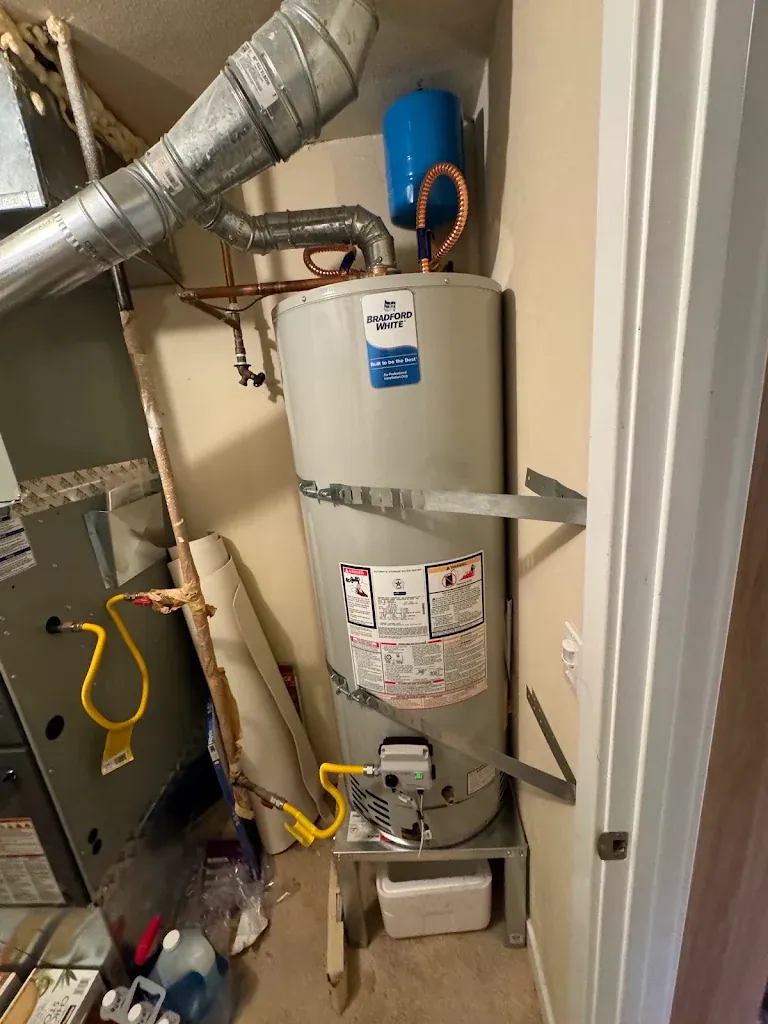
Tanks got fatter in 2015 when federal efficiency standards required more insulation. A new 50-gallon tank may not fit where the old 50-gallon tank did, especially in the small closets built into 1960s and 70s homes near the shipyard and in some manufactured homes in Mason County. Sometimes a 40-gallon gas tank with a higher recovery rate is the better fit than a 50 that does not fit the closet; sometimes the closet is the reason to go tankless.
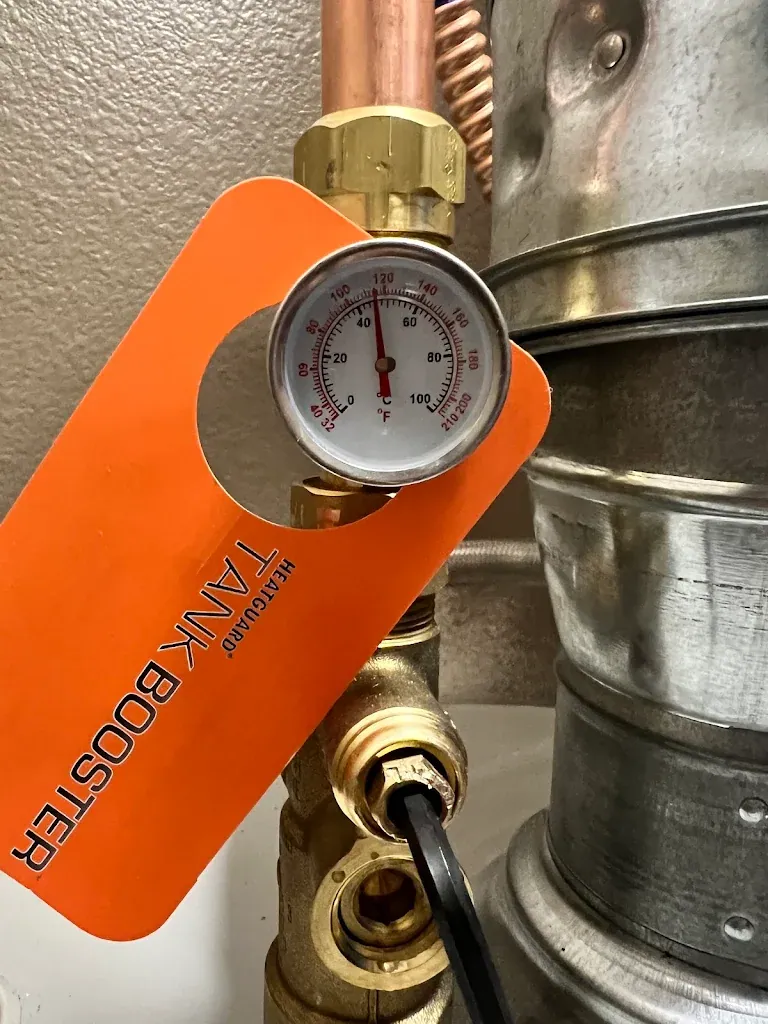
Fuel sets limits too. A gas tank needs a flue that works; a condensing gas tank or a tankless can vent sideways in plastic. A larger electric tank may need a larger breaker. A propane tankless needs a tank and regulator sized for the load. And every size and type needs a permit, strapping, a properly piped relief valve, and an expansion tank where the house has a pressure reducing valve or backflow preventer.
- Measure the closet or alcove, including height to the flue or ceiling
- Check the breaker size and panel capacity for electric units
- Confirm gas line size and meter or propane capacity for gas units
- Note the distance to the farthest fixture
- Measure the largest tub
How we size one on a service call
We ask who lives there and what the morning looks like. We measure the tub if there is one, look at the fuel supply and the panel, check the space, and ask about the far bathroom. For a tank, we pick the FHR that covers your busy hour with a little margin. For a tankless, we run the numbers at a winter inlet temperature and show you how many fixtures it supports at once. Then you get a flat-rate quote for the size that fits, and if a bigger one is a close call we quote both and explain the trade.
The goal is a heater that disappears into the background. A right-sized tank never runs out on a normal morning and does not heat sixty gallons for a household of two. A right-sized tankless lets the second shower start without anyone shouting from the bathroom.
Frequently asked
What size water heater does a family of four need?
Typically a 50-gallon electric tank or a 40- to 50-gallon gas tank, checked against the first-hour rating. If there is a large soaking tub or everyone showers in the same hour, go to the next size or consider tankless.
Is a 40-gallon water heater big enough for two people?
Almost always, yes. Two people with no large tub are well served by a 40-gallon tank in either gas or electric. A single occupant without a tub can often use a 30-gallon tank.
What size tankless water heater do I need in Washington?
Size it for a temperature rise of about 70 degrees, which is what our cold winter groundwater demands. A large residential gas tankless then supports roughly one shower plus one other fixture at the same time. Larger households need the biggest single unit or two units in parallel.
Can I replace my 50-gallon tank with a bigger one in the same spot?
Sometimes. Newer tanks are wider than older ones of the same capacity because of added insulation, and closets built in the 1960s and 70s are tight. We measure first. If a bigger tank will not fit, a high-recovery gas tank or a tankless often solves the capacity problem in the same footprint.
What size heat pump water heater should I get?
One size larger than the standard electric tank you would otherwise buy, so a home that would use 50 gallons gets a 65- or 80-gallon hybrid. Heat pump mode recovers slowly, and the extra storage keeps the unit from falling back on its electric elements.
Does a bigger water heater cost more to run?
A larger tank has more surface to lose heat through and more water to keep hot, so yes, modestly. Oversizing by one step is not a big deal; oversizing by two for a household that never uses it is wasted energy every day.
About the author. Gregory Lowe is the owner and lead plumber at Washington Plumbing & Drain, a veteran-owned company in Port Orchard serving Kitsap, Pierce and Mason counties. The guidance here comes from daily work in local homes, not from a content farm. Call (360) 812-1124 with questions.