
Short answer
A sewer line usually announces its decline before it fails outright: drains that gurgle, more than one fixture backing up at once, sewer smell indoors or in the yard, backups that follow heavy rain, a patch of lawn that stays green and spongy, and a clog that returns no matter how often it is cleared. Any one of these can have a simpler cause, but two or more together mean the pipe itself should be looked at with a camera before you spend another dollar on drain cleaning.
In this guide
Key takeaways
- Several fixtures backing up together points past the branch lines to the main drain or sewer.
- Backups that arrive with the rainy season signal groundwater getting into the pipe through cracks, joints, or root entries.
- A sunken or unusually lush strip of lawn over the sewer path is a classic sign of a leaking lateral.
- Gurgling, slow drains throughout the house, and sewer odor are earlier, quieter warnings.
- A clog that comes back repeatedly after cabling is a pipe problem, not a clog problem.
- A camera inspection is the only way to know whether you have a maintenance item or a repair, and it usually takes under an hour.
Start with the symptoms inside the house
Most sewer failures are felt indoors first. The lowest fixture in the house, often a basement floor drain, a daylight-basement shower, or the toilet closest to where the main leaves the foundation, is the canary. When water from upstairs starts rising in that fixture, the main line downstream is restricted.
Before it gets that far, you will often hear it. A toilet that burbles after the washing machine drains, or a tub that gulps air when the toilet flushes, is telling you the line is partly blocked and air is being pulled back through the traps. Gurgling from one fixture can be a venting problem; gurgling from several is a main line problem.
Slow drains everywhere at once belong on the same list. One slow sink is hair or grease. Every drain in the house creeping along, especially when it worsens over weeks, is a main that is losing diameter to roots, sludge, or a sag.
Signs that show up in the yard
A sewer lateral carries water, and when it leaks that water goes into the soil along the pipe's path. In our glacial till and clay, that moisture does not disperse quickly. The surface above a leaking line stays damp, grass grows greener and taller in a stripe, and in wet months the ground gets spongy underfoot. In dry August, that stripe may be the only green left in the yard.
Settling is the next stage. As a leak washes fines out of the soil around the pipe, the ground above it drops. A dip in the lawn, a cracked section of concrete walkway, or a driveway slab that has sunk a half inch along one edge can all be sitting over a collapsed or leaking sewer. Many of the 1960s homes around Bremerton and Port Orchard had driveways poured right over the lateral, and the weight of decades of vehicles has crushed more than a few.
Odor outdoors is the sign people dismiss. A sewer smell near the foundation, around a cleanout, or over the line path on a warm day means sewage is reaching the soil surface or gas is escaping a broken joint. That is not a cleaning problem.
The rainy-season pattern
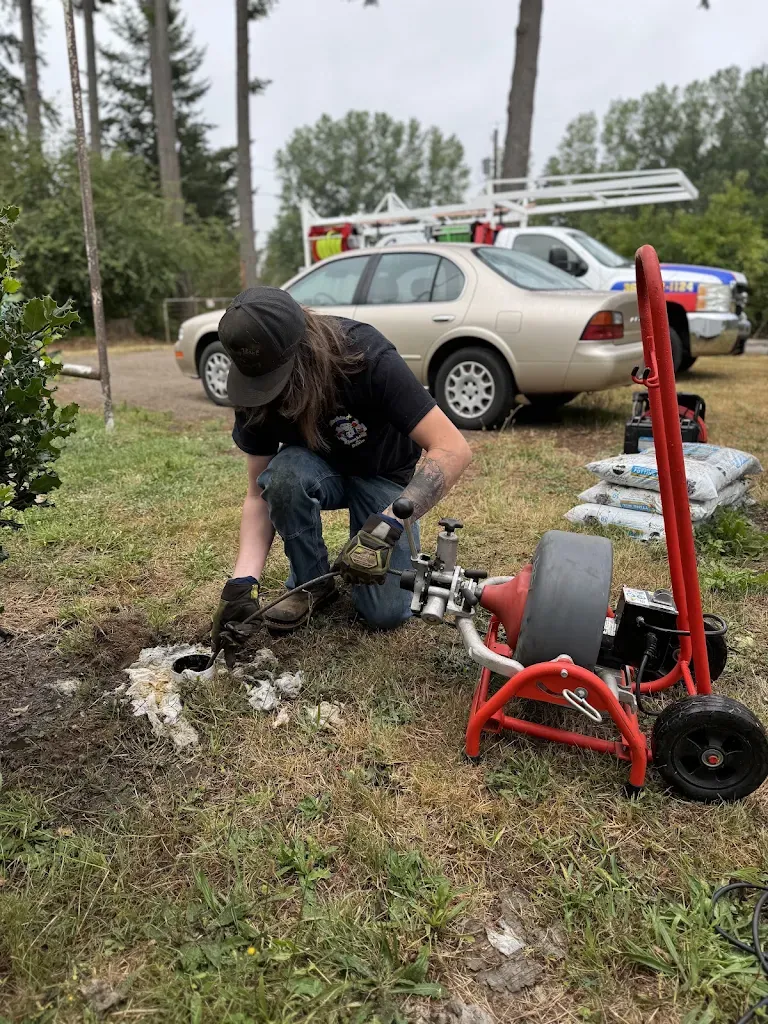
A sewer line that behaves all summer and backs up every November is one of the most common calls we get from October through April. The cause is infiltration. Cracks, separated joints, and root entry points let groundwater pour into the pipe when the water table rises, and that water carries silt and fills the line. During an atmospheric river the volume can overwhelm the pipe entirely.
Homes on the low ground near Sinclair Inlet, in the older parts of Manchester and Southworth, and on waterfront lots along Hood Canal see this most. If your backups track the weather, the pipe is open to the soil somewhere, and the camera will show water streaming in at the problem joints.
The opposite pattern, trouble in the driest months, usually points to roots. Trees go looking for water in August, and a sewer joint seeping moisture is the best thing in the yard. Root mass builds through summer and fall, then the first rains flush debris into it and the line stops.
The clog that will not stay fixed
This is the sign we take most seriously. A main line that needs cabling every six months, or every spring, or three times in a year, has a reason. Something in the pipe is catching material: a root ball, a bellied section holding standing water and sludge, an offset joint where one pipe section has dropped below the next, or crumbling cast iron with a bottom so rough that paper snags on it.
Drain cleaning is cheap and effective for a clog. It is a poor substitute for a repair. Homeowners sometimes spend years paying for cabling when a camera would have shown a single bad joint that could be dug up and replaced in a day. We would rather show you the footage and let you decide than keep taking the same service call.
Material and age tell you what to expect
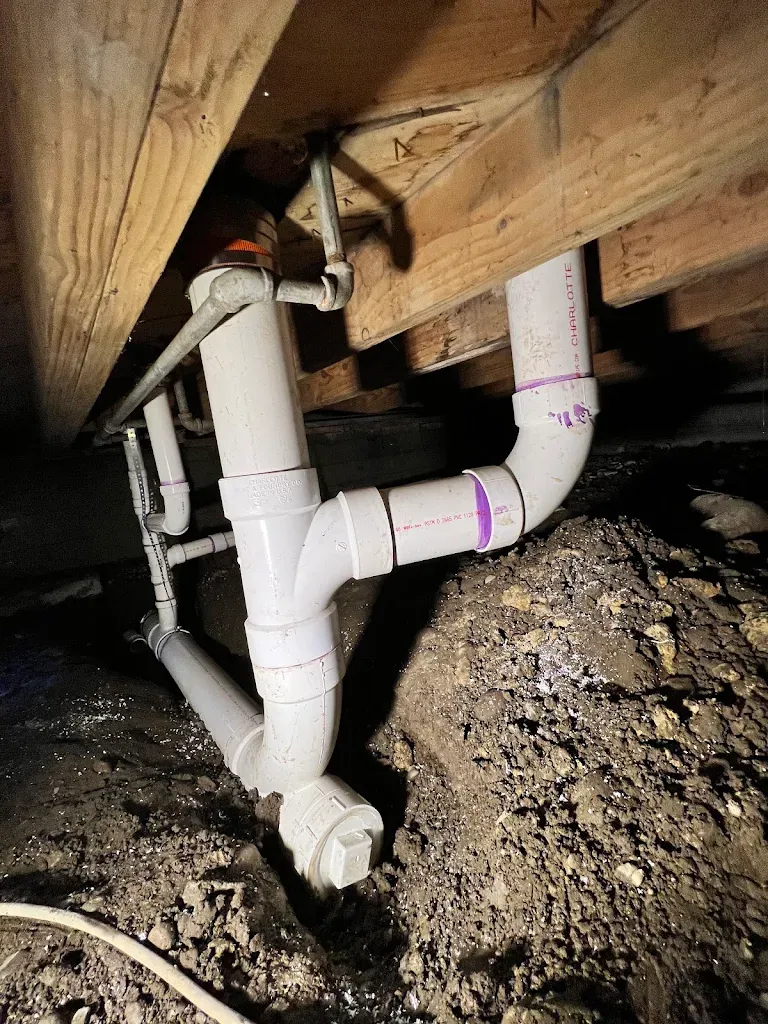
Houses near PSNS and downtown Bremerton from the 1940s through the 1960s often have cast iron under the house transitioning to clay, concrete, or Orangeburg in the yard. Clay tile joints are where roots get in. Concrete pipe loses its interior to acidic sewer gas. Orangeburg, a tar-and-fiber product, slowly flattens into an oval and then collapses. All of these are near or past the end of their service life.
Homes from the 1970s onward mostly have ABS or PVC, which does not corrode or get eaten by roots the same way. They fail differently: a settled section that creates a belly, a joint pulled apart by ground movement on a steep lot, or a crushed spot under a later driveway or patio. Newer tract homes in Silverdale and Gig Harbor North rarely have sewer trouble unless something was built over the line.
If you do not know what your line is made of, the camera answers that in the first few feet. Knowing the material tells us whether repeated cleaning is a reasonable plan or just delaying the inevitable.
A checklist worth running before you call
You cannot see inside the pipe, but you can gather evidence that makes the diagnosis faster. A few minutes of observation often lets us arrive with the right truck.
- Which fixtures are affected, and does one fixture's use cause another to back up or gurgle
- Whether the problem follows heavy rain, or shows up in dry months
- How many times the line has been cleared in the past two years, and what the last plumber found
- Whether there is a cleanout outside, and whether water or sewage stands in it when drains are slow
- Any soft, sunken, or extra-green ground between the house and the street or septic tank
- Age of the house, and any records of previous sewer work
- Whether the house is on municipal sewer or septic, since the next step differs
What the camera inspection shows and what happens next
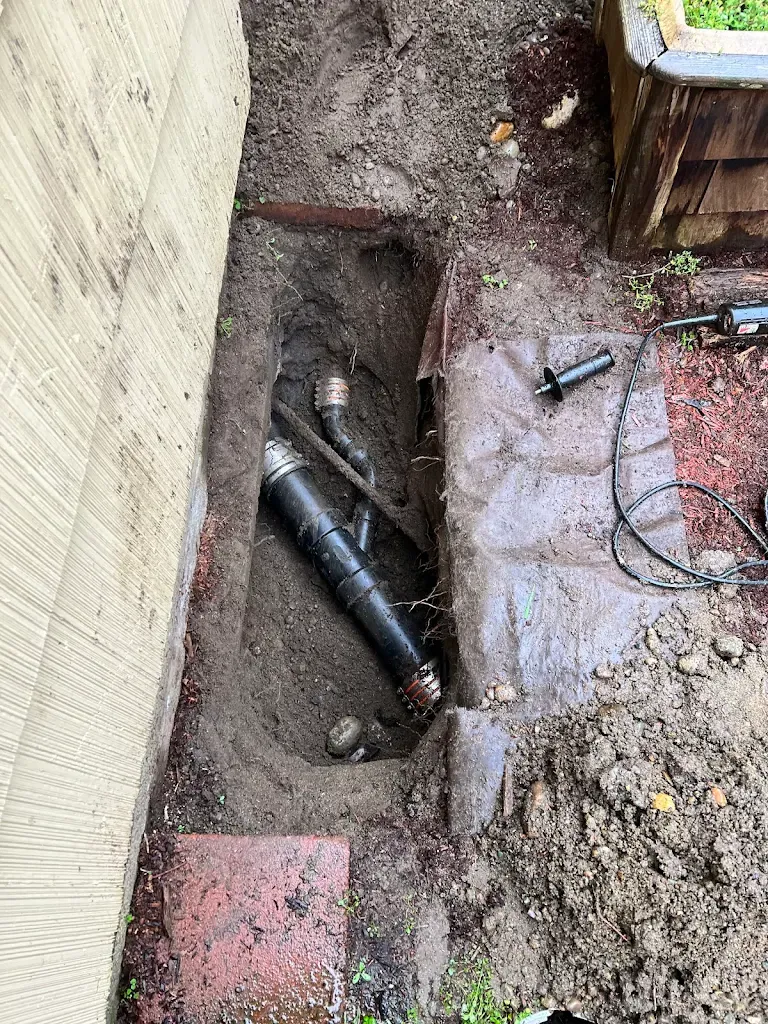
We open the line with a cable if needed so the camera can travel, then push a color camera through the pipe with a locating transmitter in its head. On the monitor you see the pipe wall, every joint, any roots, standing water in bellies, and the condition of the material. From outside, we trace the transmitter to mark exactly where any problem sits and how deep it is.
Three outcomes are typical. The line is sound and the clog was a one-off, so you need nothing more. The line has a recurring issue in a pipe that can take it, so a maintenance plan with periodic jetting or cabling makes sense. Or the line has a defect, a crushed section, a collapsed joint, a failed Orangeburg run, and a spot repair or replacement is the honest recommendation. We do that work by excavation with new cleanouts, and we give you a written flat-rate estimate you can take your time with.
For septic homes, the same camera inspection applies to the line from the house to the tank. Problems at the tank itself, with baffles or the drainfield, are septic-company territory, and we will say so rather than guess.
Frequently asked
How do I know whether it is the sewer line or just a clogged drain?
One fixture acting up is almost always a local clog. Multiple fixtures, especially on different floors, backing up or gurgling together means the main drain or sewer is restricted. Weather-related backups and repeat clogs push the odds further toward the sewer line itself.
Can a sewer line fail without any backup inside the house?
Yes. A leaking lateral can drain sewage into the soil for years with the house draining normally. Soft ground, a green stripe, odor in the yard, or unexplained settling of a walkway are the clues. A camera finds the leak before it becomes a collapse.
My drains back up only when it rains hard. Is that the city's problem?
Sometimes the municipal main is surcharged during a storm and the utility is responsible for that. More often, groundwater is entering your own lateral through cracks or joints. A camera during or just after rain shows water pouring in at the defects, which settles the question.
Is a sunken spot in my lawn definitely a sewer problem?
Not definitely, but it is worth checking when it sits along the sewer path. Leaking water lines, old stumps rotting out, and poorly compacted fill also cause settling. The camera, plus a locate of where the sewer actually runs, tells you which.
How urgent is a failing sewer line?
A line that is restricted but flowing can usually be scheduled within days. Sewage backing up into the house, sewage surfacing in the yard, or a line that will not clear at all are same-day calls. We answer evening and weekend emergencies for exactly those situations.
Will insurance cover a sewer line repair?
Standard homeowner policies often exclude the underground line itself but may cover damage from a backup if you carry a sewer backup endorsement. Some policies offer service line coverage as an add-on. We provide camera footage and written findings that help with a claim; the policy terms are between you and your insurer.
About the author. Gregory Lowe is the owner and lead plumber at Washington Plumbing & Drain, a veteran-owned company in Port Orchard serving Kitsap, Pierce and Mason counties. The guidance here comes from daily work in local homes, not from a content farm. Call (360) 812-1124 with questions.