Short answer
Water expands when it is heated, and in a home where a pressure reducing valve, check valve or backflow preventer stops that expansion from pushing back into the utility main, the pressure inside the pipes climbs with every heating cycle until something gives, usually the water heater's relief valve. A thermal expansion tank is a small steel tank with an air-charged rubber bladder that absorbs that extra volume and keeps pressure steady. The plumbing code requires one on any closed water system, which includes most homes built or re-plumbed in Kitsap, Pierce and Mason counties in the last few decades, and it needs its air charge checked yearly and replacement when the bladder fails.
In this guide
Key takeaways
- Heating a tank of water from cold to hot adds a few quarts of volume that has to go somewhere. In a closed system, that somewhere is pressure.
- A pressure reducing valve, a backflow preventer or a check valve at the meter makes a system closed. Most newer local homes have at least one.
- A dripping temperature and pressure relief valve is the classic sign of a missing or failed expansion tank.
- The tank's air charge must match the house pressure, and the bladder wears out; tap it, and if it sounds solid and heavy it is waterlogged.
- Code requires an expansion tank on closed systems, and inspectors look for one on every water heater permit.
- Thermal expansion is not water hammer. Banging pipes are a different problem with a different fix.
The physics in one paragraph
Water does not compress. When a water heater warms fifty gallons from cold groundwater in the forties to 120 degrees, that water takes up a little more room than it did, somewhere around half a gallon to a gallon depending on the temperature swing. In an open system, the extra volume pushes backward through the service line into the utility main and nobody notices. In a closed system it cannot go anywhere, so the pressure in every pipe in the house rises with each heating cycle, sometimes to well over 100 psi, until a valve opens or a weak spot fails.
What makes a home a closed system
Three common devices turn an open system closed. The first is a pressure reducing valve, the bell-shaped brass valve on the main line that knocks utility pressure down to something the house can live with. Most PRVs contain a check that stops reverse flow. Nearly every tract home built in Silverdale, Gig Harbor North, South Kitsap and the Pierce suburbs in the last thirty years has a PRV because the district pressure on the main is too high for fixtures.
The second is a backflow preventer, required by utilities on many services and by code on irrigation and some fire sprinkler connections. Water districts in Kitsap and Pierce have added check valves at the meter on many services over the years to protect the public supply, which closes the system whether the homeowner knows it or not. The third is any check valve on the house side, including the ones in some water meters and in whole-house filtration bypass setups.
Well homes are usually open in the sense that matters, because the pressure tank at the pump does the same job an expansion tank does and absorbs the extra volume. A well home with a check valve between the pressure tank and the water heater is the exception, and it needs an expansion tank just like a city home.
What thermal expansion does to a house without one
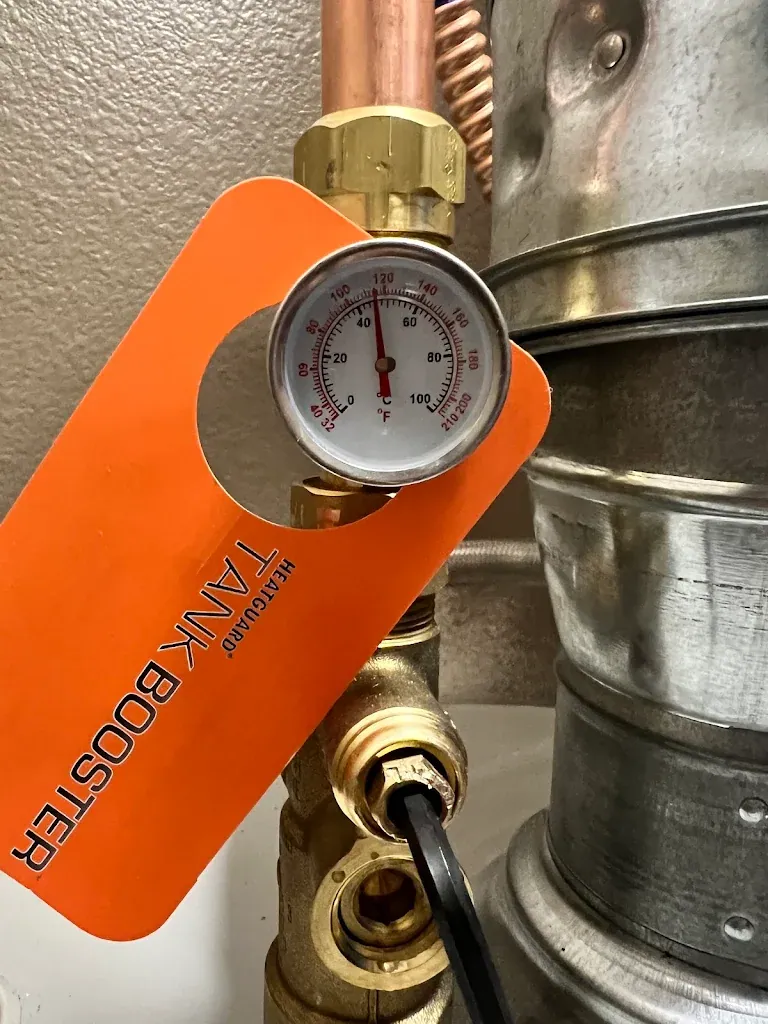
The temperature and pressure relief valve on the water heater is set to open at 150 psi. Without an expansion tank, pressure spikes during each heating cycle can reach that number, and the valve opens briefly and drips onto the floor or into its discharge pipe. Homeowners see a small puddle by the heater, or a wet spot where the discharge line ends, and assume the valve is faulty. The valve is doing its job. Replacing it does nothing, and we get called to look at brand-new relief valves that drip exactly like the old ones.
The spikes also wear everything else. Toilet fill valves start running. Faucet cartridges and supply lines fail early. The water heater's glass lining and the tank itself flex with every cycle, which shortens its life. Washing machine hoses bulge. A house running 60 psi with no expansion tank can see momentary pressure far above what its fixtures were made for, and the parts fail one at a time without anyone connecting the failures to the cause.
How an expansion tank works
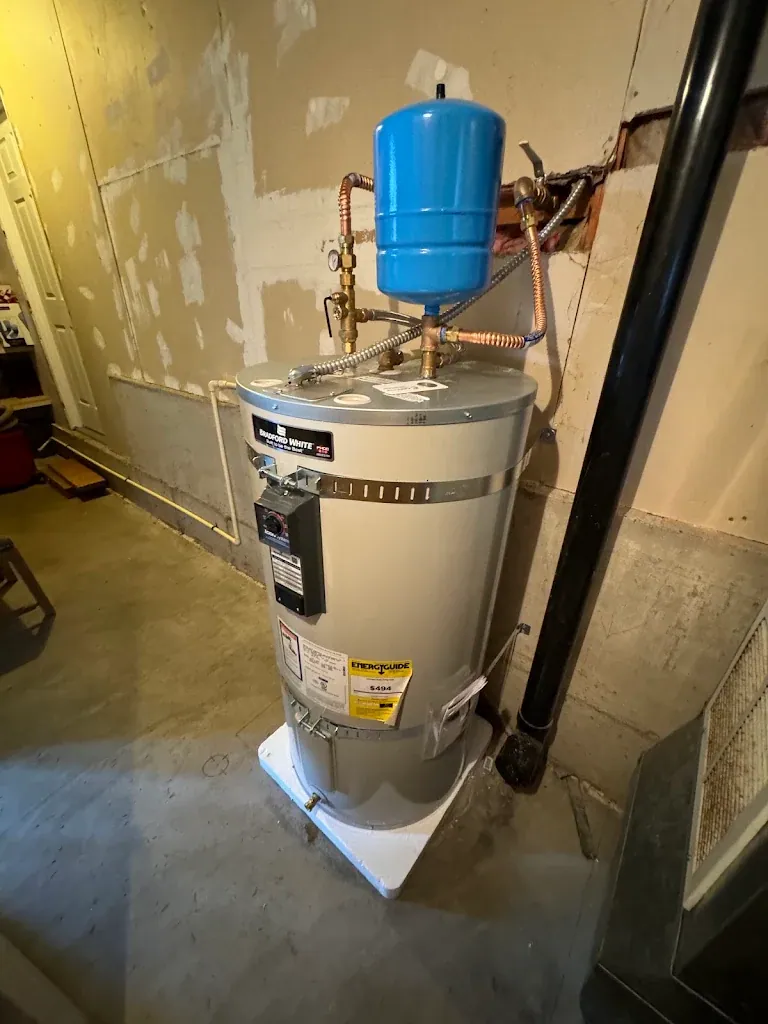
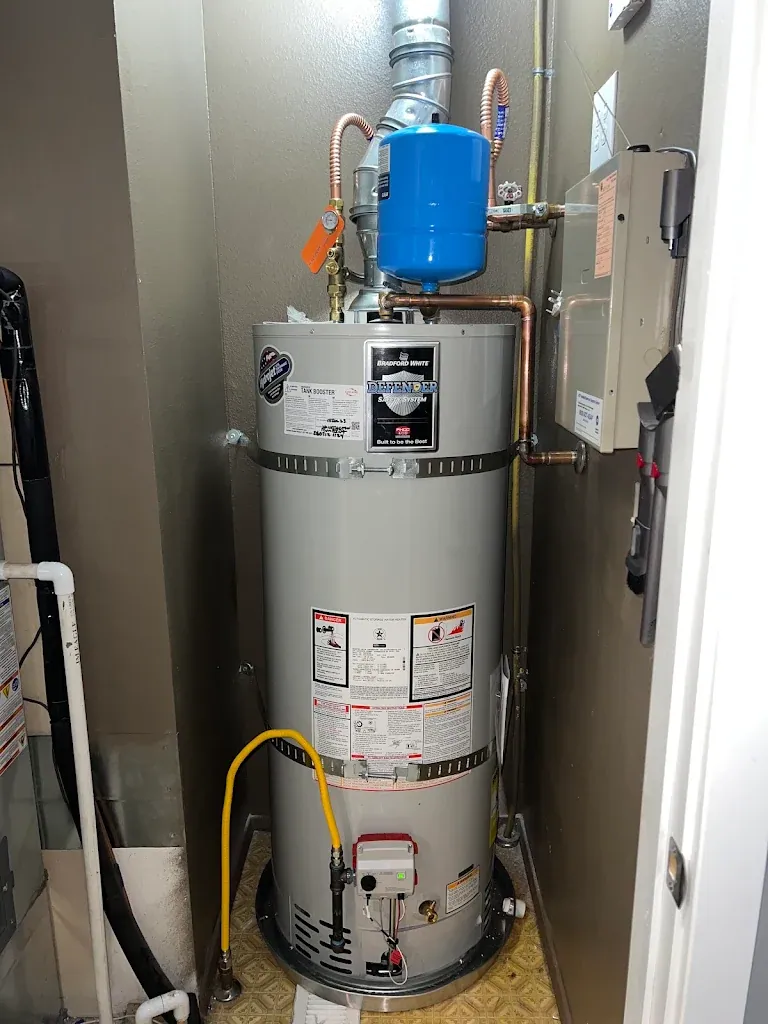
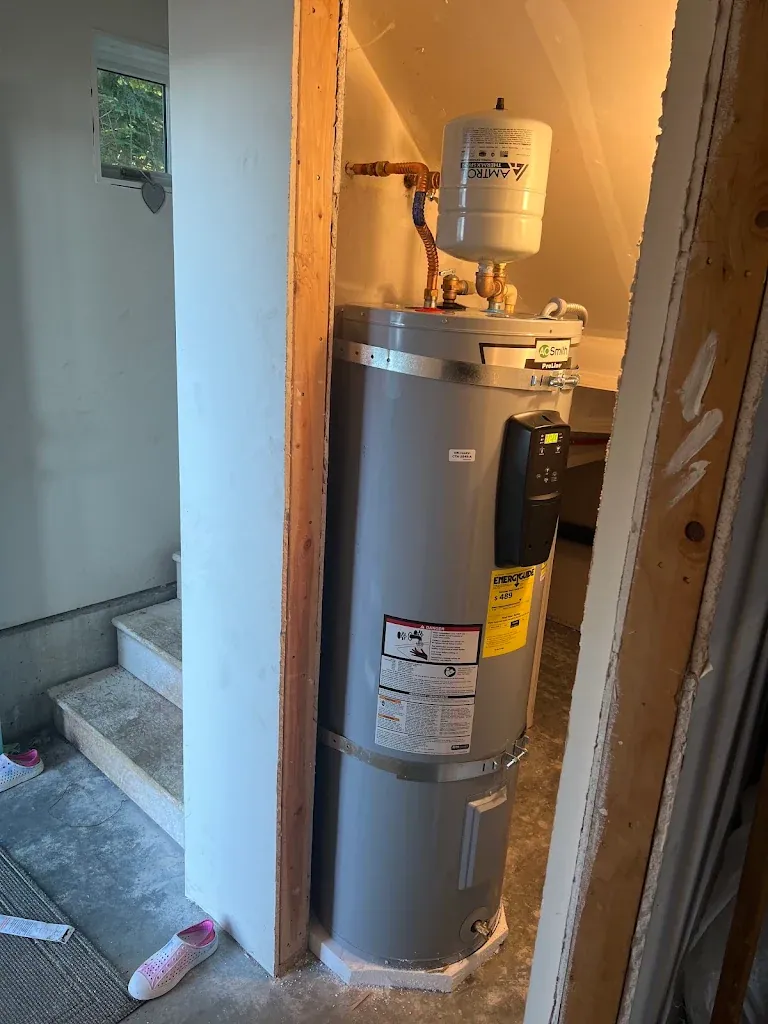
An expansion tank is a small steel cylinder, typically about the size of a football for a residential water heater, with a rubber diaphragm or bladder dividing it in two. One side connects to the cold water line near the heater. The other side holds air, pre-charged through a Schrader valve like a tire. When the heater runs and the water expands, it pushes against the bladder and compresses the air a little, taking up the extra volume without raising system pressure much. When hot water is drawn, the air pushes the water back out.
The air charge has to match the house pressure for this to work. A tank charged to 40 psi in a house running 65 psi has its bladder pushed all the way back before heating even starts and absorbs nothing. We check the house pressure with a gauge and set the tank's charge to match before it goes in. We install Amtrol and Well-X-Trol tanks sized to the water heater; most 40- to 50-gallon residential heaters use a two-gallon tank, larger heaters and high-pressure homes use a bigger one.
How to tell if yours is failing
Expansion tanks fail in two ways. The bladder develops a leak and water fills the air side, so the tank is full of water and absorbs nothing. Or the air charge slowly bleeds off through the Schrader valve and the bladder has no room left. Either way the symptoms are the same as having no tank: a relief valve that drips, pressure that reads high on a gauge after the heater runs, and fixtures that fail early.
The homeowner test is simple. Tap the tank with a knuckle. A healthy tank sounds hollow on the air side and solid on the water side, and feels light for its size. A waterlogged tank sounds dull everywhere and is heavy. Press the pin in the Schrader valve briefly; air should come out. Water coming out means the bladder has failed and the tank needs replacing. Checking the charge with a tire gauge, with the water pressure off the tank, should read close to the house pressure.
- Tap test: hollow is good, dull and heavy means waterlogged
- Schrader valve: air is good, water means a failed bladder
- Relief valve dripping after the heater runs points to the expansion tank first
- A pressure gauge on a hose bib reading much higher after a heating cycle than before
Where it goes and how it is installed
The tank mounts on the cold water line feeding the water heater, after the shutoff valve and before the tank, so it is on the house side of any check valve and can see the heater. It can hang vertically or horizontally depending on the model and the manufacturer's instructions; a horizontal tank should be supported, since a waterlogged one gets heavy and can stress the fitting. We tee it in with a proper fitting and a support strap, set the charge, and confirm the house pressure with a gauge.
Every water heater installation we do includes checking whether the home is a closed system and adding an expansion tank where it is. The inspector on the water heater permit looks for one on closed systems, and a missing tank is one of the more common reasons a heater install fails inspection when someone else did it. If the house pressure is also high, a PRV adjustment or replacement goes in at the same visit, since an expansion tank cannot fix a house running at 95 psi all day.
Expansion tanks and the rest of the pressure picture
Thermal expansion is one cause of high pressure; the PRV is another; and a dead expansion tank is a third. Sorting them out takes a gauge and a few minutes. We put a gauge on a hose bib, read it with the heater idle, then read it again after a heating cycle. A steady high reading is the PRV. A reading that climbs after heating is expansion, and then we look at the tank. We also test the relief valve by lifting its lever briefly, because a relief valve that has been dripping for months can be scaled and may not reseat.
People sometimes confuse thermal expansion with water hammer, the bang when a valve closes fast. That is a momentum problem, handled with hammer arrestors at the washing machine or dishwasher, and an expansion tank does not fix it. Our pipes-banging problem page covers it.
Maintenance and lifespan
An expansion tank is cheap and quietly wears out. Check the charge once a year with a tire gauge and the tap test, which fits easily into the yearly water heater flush. Most last five to ten years; a tank in a house with high pressure or a lot of heating cycles goes sooner. Replace it when it is waterlogged or when the water heater is replaced, since a new heater with a ten-year-old expansion tank is a mismatch and the labor overlap makes it the right time.
If you are on well water, your pressure tank is doing this job, and the thing to check there is the pressure tank's own air charge, for the same reasons. A waterlogged well pressure tank makes the pump short-cycle, which is covered in our pressure tank troubleshooting guide.
Frequently asked
Do I need an expansion tank on my water heater?
If your home has a pressure reducing valve, a backflow preventer, or a check valve at the meter, yes, and the plumbing code requires it. Most homes built or re-plumbed in Kitsap, Pierce and Mason counties in recent decades have at least one of those. We check when we install or service a heater.
Why is my water heater relief valve dripping?
Most often because the system is closed and there is no working expansion tank, so pressure spikes during heating open the relief valve. Replacing the valve does not fix it. Check the expansion tank first; if the tank is waterlogged or missing, that is the repair.
How do I know if my expansion tank is bad?
Tap it. A good tank sounds hollow on the air end and feels light. A bad one sounds dull all over and is heavy. Press the Schrader valve on the end; air is fine, water means the bladder has failed.
How long does an expansion tank last?
Five to ten years in most homes. Replace it when the bladder fails or the water heater is replaced. Checking the air charge once a year with a tire gauge extends its life.
Can an expansion tank be installed on a tankless water heater?
Yes, and it is still needed on a closed system because a recirculation loop or the small volume in the exchanger still expands. It is less critical than with a tank heater but the code treats the system the same way.
Does a well home need an expansion tank?
Usually not, because the well's pressure tank absorbs expansion. The exception is a check valve installed between the pressure tank and the water heater, which closes the house side off. If your well home has a dripping relief valve, that is the thing to look for.
About the author. Gregory Lowe is the owner and lead plumber at Washington Plumbing & Drain, a veteran-owned company in Port Orchard serving Kitsap, Pierce and Mason counties. The guidance here comes from daily work in local homes, not from a content farm. Call (360) 812-1124 with questions.