What it usually looks like
- A single loud bang when the washing machine or dishwasher fill valve shuts
- A thud inside the wall when a toilet finishes filling
- Pipes knock when you shut a faucet quickly but not when you close it slowly
- A rattling or machine-gun sound while water is running
- Noise got worse after a new washer, fridge with ice maker, or water heater was installed
- A humming or whining that changes pitch when you crack a faucet open
Likely causes, most common first
Fast-closing solenoid valves
Washing machines, dishwashers, ice makers and some toilet fill valves close electrically in a fraction of a second. The water in the supply line was moving at several feet per second and has nowhere to go, so it hits the valve like a hammer. This is the most common cause in newer homes in Silverdale and Gig Harbor North, where everything is a solenoid.
House water pressure that is too high
Water hammer energy rises with pressure. Many homes on the lower side of Port Orchard, in parts of Bremerton and along the Tacoma waterfront see 90 to 120 psi from the street because the pressure reducing valve has failed or was never installed. At that pressure even an ordinary faucet can bang.
Pipes that are not strapped or have lost their straps
Copper and PEX both need to be secured every few feet. In crawlspaces that have flooded, or where a previous remodel left pipe hanging, the pipe swings when a valve closes and slaps a joist. That is more of a rattle than a hammer, but it is just as annoying and it wears the pipe.
Waterlogged or missing air chambers
Older homes were often built with capped vertical stubs near fixtures that held a cushion of air. Over the years those air pockets dissolve into the water and the stubs fill, leaving no cushion. Draining the house sometimes recharges them, but not for long.
A failing pressure reducing valve or check valve
A PRV with a worn diaphragm can chatter, and a check valve that flutters will tap repeatedly. These sound like hammer but happen while water is flowing, not just at shutoff. A water meter with a backflow check can also contribute by trapping thermal expansion pressure.
Thermal expansion with no expansion tank
If your water heater has no expansion tank and the system is closed by a PRV or check valve, pressure spikes every time the heater fires. The spike makes hammer worse and can also cause the relief valve to weep.
Safe things to check yourself first
- Figure out which fixture triggers the bang. Run each one alone and shut it off. The culprit is usually the washing machine or a toilet.
- Buy or borrow a hose-thread pressure gauge, screw it onto an outside spigot, and read static pressure. Over 80 psi is too high.
- Look at exposed pipe in the crawlspace, garage or utility room for sections that move when a valve closes. Secure them with proper clamps, not wire.
- Try the old air-chamber trick: shut the main, open the highest and lowest faucets until the house drains, close them, and reopen the main. If the noise goes away for a while, you have air chambers that waterlogged.
- Check the washing machine hoses. Replace rubber hoses with braided stainless, and if the hoses have small arrestors on them, make sure they are oriented correctly.
Stop and call if
- Pressure on your gauge reads above 80 psi, or above 100 psi at night
- You can see a pipe joint weeping or a fitting that has shifted after the banging
- The water heater relief valve has started dripping along with the noise
- Hammer began suddenly after a freeze, which can mean a cracked fitting moving in the wall
- The noise is a constant vibration or whine that does not stop when all fixtures are off
How we diagnose and fix it
- Measure static and dynamic pressure at the house, overnight if needed with a recording gauge, to rule high pressure in or out.
- Replace or install a pressure reducing valve set to a sensible 55 to 65 psi when pressure is the driver.
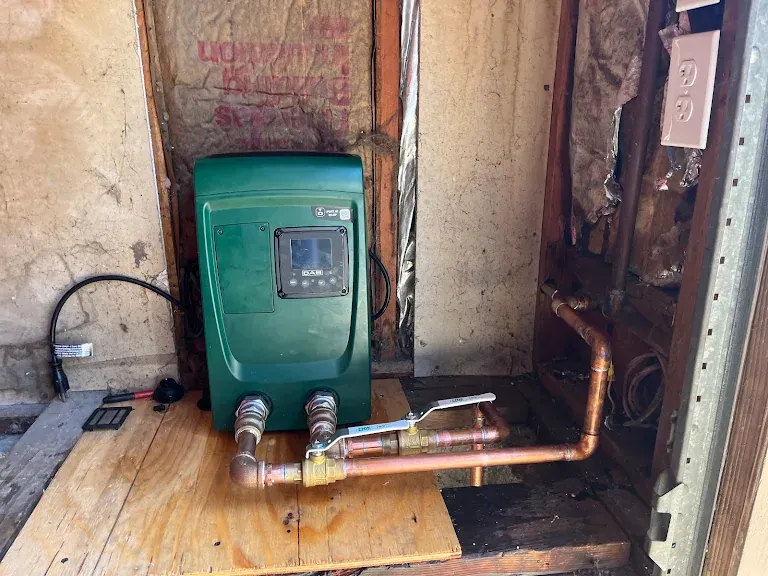
- Install engineered water hammer arrestors at the washing machine box, dishwasher supply, ice maker line and any toilet that bangs. These are sealed piston units that do not waterlog like old air chambers.
- Add a thermal expansion tank at the water heater if the system is closed and one is missing.
- Trace exposed and accessible pipe runs and strap or cushion them properly, including crawlspace runs that were left loose.
- Replace chattering PRVs, check valves or fill valves that are making noise while flowing rather than at shutoff.
Around Kitsap, Pierce and Mason counties
Water hammer calls spike in our area in two situations. The first is the newer subdivisions off Highway 16 and in Silverdale where the municipal pressure is strong and every appliance has a solenoid. The second is older homes in Bremerton and Port Orchard served by gravity-fed systems from reservoirs high on the hill, where pressure climbs at night and the original PRV quit years ago. Homes on wells rarely hammer unless the pressure switch is set unusually high or a booster pump is cycling.
Questions people ask
Can water hammer actually damage my plumbing?
Yes. Each bang is a pressure spike that can be several times the static pressure. Over time that loosens solder joints, wears out washing machine valves, cracks PEX crimp rings and stresses the water heater. It is not just a noise.
Is water hammer the same as the rattle I hear when the water runs?
No. Hammer is a bang at shutoff. A rattle, hum or chatter while water is flowing is usually a loose pipe, a worn washer vibrating in a faucet or a PRV diaphragm fluttering. We fix both, but the diagnosis is different.
Do those screw-on arrestors from the hardware store work?
For a washing machine, often yes, if the pressure is normal. They do nothing for a toilet or dishwasher inside the wall, and they will not help if the real problem is 110 psi from the street.
Why did the banging start right after my new water heater was installed?
Usually because the installer added a check valve or a PRV that closed the system without adding an expansion tank. The resulting pressure spikes make every shutoff bang. Adding the expansion tank normally quiets it.
Can you fix water hammer without opening walls?
Most of the time. Pressure fixes happen at the main, arrestors go at the washer box or under a sink, and expansion tanks mount at the heater. Opening a wall is only needed when a pipe is loose inside it and cannot be reached any other way.