
Short answer
Filtration around Puget Sound splits into two worlds. City water from Bremerton, Port Orchard, Silverdale, Poulsbo, Tacoma and the districts is soft and well treated, so the useful add-ons are a carbon filter for chlorine taste and a sediment filter if the house has old pipe. Well water in Kitsap and Mason County often needs real treatment for iron, manganese, sulfur odor, low pH, or bacteria, and the right system depends entirely on a lab test. A softener is seldom the answer here because the water is not hard; iron filters and carbon do most of the work.
In this guide
- Start with what is actually in your water
- Sediment filters: the first stage for almost everyone
- Carbon filters for chlorine, taste and odor
- Iron and manganese: the Kitsap and Mason County specialty
- Sulfur smell, low pH and bacteria
- Softeners, and why we rarely push them here
- Whole-house versus point-of-use
- Installing it so it keeps working
Key takeaways
- Test before you buy. A lab panel tells you what is in the water; a salesman's test strip does not.
- City water around Kitsap and Pierce County is soft; a carbon filter for chlorine and a sediment filter are usually all that helps.
- Well water here commonly needs iron and manganese removal, sulfur treatment, or pH correction. Hardness is rarely the main issue.
- Whole-house filters treat every tap; reverse osmosis treats drinking water at one tap. Many homes want both.
- UV disinfection is the standard fix for a well that tests positive for bacteria, and it needs clear, filtered water ahead of it.
- Every filter has a cartridge or media life; a system no one maintains becomes the problem it was meant to solve.
Start with what is actually in your water
If you are on a utility, the answer is already written down. Every public water system publishes an annual water quality report listing what was tested and found. Bremerton, for instance, reports that its water is not considered hard and that a softener is generally not needed. Read your utility's report before you spend money, and you will find that the realistic complaints on city water are chlorine taste and odor, occasional sediment from main flushing, and old galvanized pipe inside the house shedding rust.
If you are on a well, nothing is written down until you test. A certified lab panel covering bacteria, nitrate, iron, manganese, hardness, pH, total dissolved solids, and arsenic costs a modest amount and takes a week. We will not size or recommend a treatment system without one, and you should be suspicious of anyone who will. The common well findings in Kitsap and Mason County are iron and manganese well above the aesthetic standards, hydrogen sulfide odor, and low pH; hardness here is usually mild.
Sediment filters: the first stage for almost everyone
A sediment filter is a housing with a cartridge that catches sand, silt, rust flakes, and pipe scale. On a well it protects everything downstream, including the pressure switch, the water heater, and finer filters. On city water it earns its place in houses with galvanized pipe or in neighborhoods where hydrant flushing sends brown water through the lines a few times a year.
Cartridges come in micron ratings; a coarse 20 or 50 micron pleated filter handles sand and rust on a well, and a 5 micron filter polishes behind it. A spun or pleated cartridge needs changing when the pressure drop across it climbs, which on an iron-heavy well can be monthly and on city water can be yearly. Clear housings or pressure gauges on both sides tell you when.
Carbon filters for chlorine, taste and odor
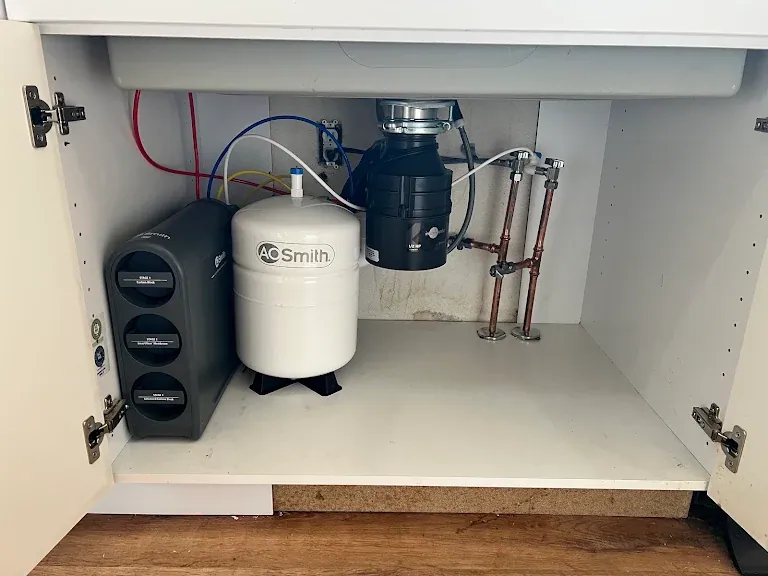
Activated carbon grabs chlorine, chloramine, and the organic compounds that give water a musty or chemical taste. For city water customers who dislike the taste or whose skin reacts to chlorine in the shower, a whole-house carbon filter is the single most noticeable improvement available. Larger backwashing carbon tanks last years; cartridge-style carbon blocks are cheaper up front and need regular replacement.
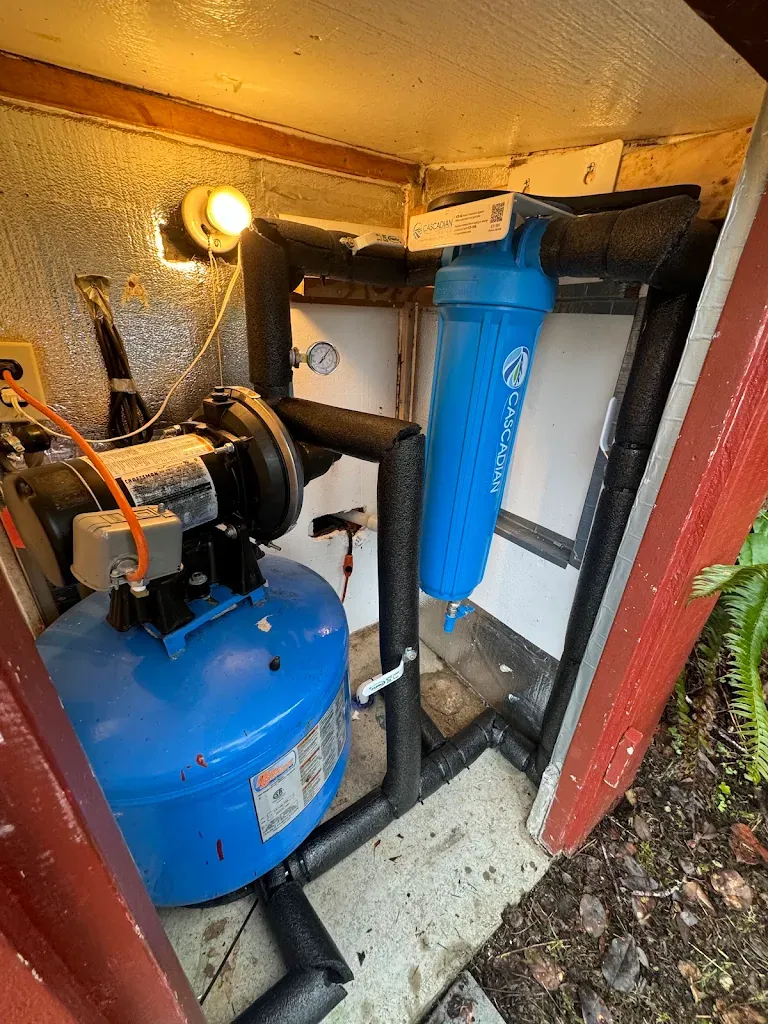
Carbon also helps with some sulfur odors and certain organics in well water, though it is not a complete fix for strong hydrogen sulfide. Halo and Cascadian are among the whole-house systems we install, chosen for the house's flow rate and the water test rather than the brand name on the tank.
Iron and manganese: the Kitsap and Mason County specialty
Orange stains in the toilet, black slime in the tank, brown laundry, and a metallic taste are iron and manganese, and they are the most common reason a well owner here calls us. Dissolved iron and manganese pass through a sediment filter untouched; they have to be oxidized into particles and then filtered. A dedicated iron filter does both, using a catalytic media, air injection, or an oxidant feed ahead of a filter tank that backwashes itself.
Which design fits depends on the numbers from the test and whether the metals are dissolved or already oxidized, which the water's clarity when first drawn tells you. Manganese is harder to remove than iron and often needs a higher pH or a specific media. Getting this right is the difference between a system that works for a decade and one that stains the sink again in six months.
A water softener can handle small amounts of dissolved iron as a side effect, which is why softener salesmen sell them for iron. In this region that is usually the wrong tool: the water is not hard enough to need softening, and the iron level is often more than a softener can manage without fouling its resin.
Sulfur smell, low pH and bacteria
Hydrogen sulfide gives water a rotten-egg odor, often worse in hot water. When it is only in the hot side, the cause is usually the water heater's anode rod reacting with sulfur bacteria, and swapping to a different anode or treating the tank fixes it. When it is in cold water too, the sulfur is in the well, and treatment means oxidation through air injection, an oxidizing media, or chlorination followed by carbon.
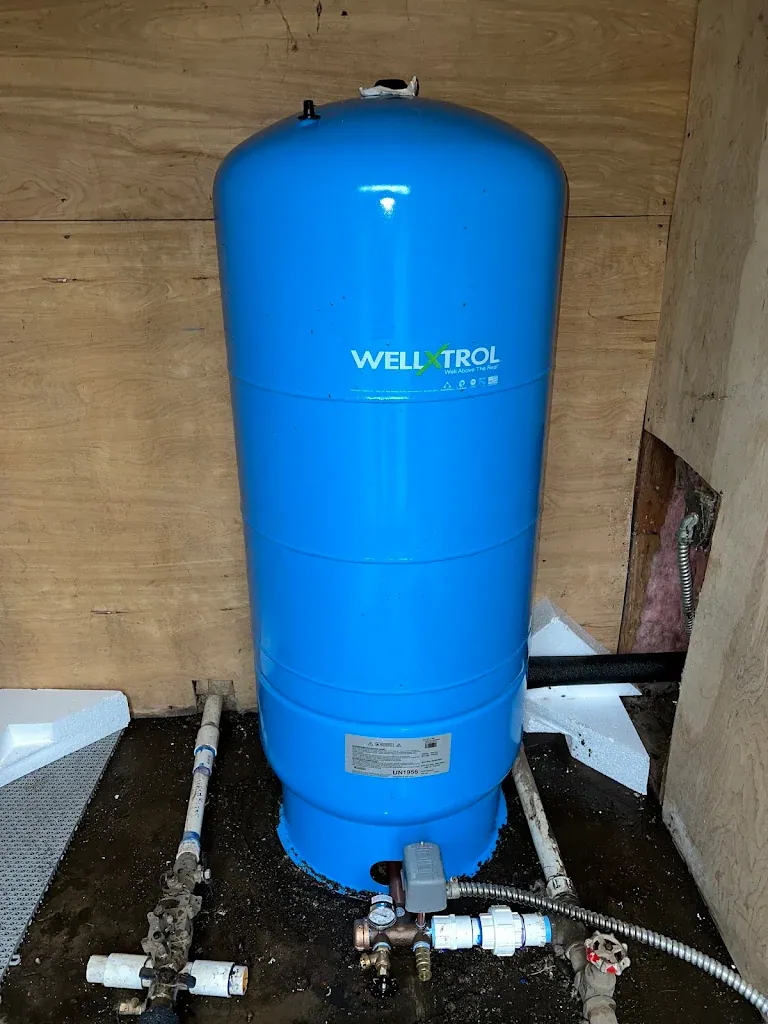
Low pH water, which some local wells produce, is corrosive. It leaves blue-green stains from copper pipe, pinholes copper over time, and tastes sharp. A calcite neutralizer tank raises the pH by dissolving a little calcium into the water, which incidentally adds a touch of hardness. On a house with copper pipe and acidic well water, this filter protects the plumbing itself.
A positive bacteria test is the one result that is a health matter rather than an aesthetic one. Kitsap Public Health District recommends annual bacteria testing for exactly that reason. The standard fix after shock-chlorinating the well is an ultraviolet disinfection unit on the house supply, which kills bacteria with light as water passes through. UV needs clear water to work, so it is installed after sediment and iron filtration, and its lamp is replaced on schedule.
Softeners, and why we rarely push them here
A softener swaps calcium and magnesium for sodium using resin and salt. It is the right answer in regions with hard water and heavy scale. Around Puget Sound, utility water measures in the low single digits of grains per gallon, and most local wells are only modestly harder. For that water a softener adds salt, maintenance, and wastewater for little visible benefit.
There are exceptions. A well on the harder side with a tankless water heater benefits from softening to protect the heat exchanger. A household that simply prefers the feel of softened water can have it. But if the complaint is stains, odor, or taste, a softener is not the fix, and we will say so even when a competitor has already quoted one.
Whole-house versus point-of-use
Whole-house, or point-of-entry, systems treat all the water as it enters the building. They are the right place for sediment, carbon, iron, pH and UV, because those problems affect showers, laundry, and appliances as much as drinking water. Point-of-use systems, chiefly reverse osmosis under the kitchen sink, polish drinking and cooking water to a higher standard than you would ever need in the shower.
Many homes end up with a layered setup: a sediment filter and iron filter for the house, and an RO at the sink for drinking water. That is a sensible combination, not an upsell, because each stage does a job the other cannot. We lay out the options with the test results on the table and let you choose which problems are worth solving.
Installing it so it keeps working
Treatment equipment needs a few things the house may not have: a bypass loop so the house can run while a filter is serviced, a drain for backwashing tanks, an electrical outlet for UV and air-injection systems, and space to actually change a cartridge. Crawlspace installs in Kitsap ramblers and well houses in Mason County both call for planning. We also put a sediment filter ahead of everything, since iron media and UV lamps both fail early on dirty water.
Then there is the maintenance conversation, which we have before the install rather than after. Cartridges, media, UV lamps and salt all have schedules. We label the system, write the dates on it, and tell you what to watch for. A filter you understand is a filter that keeps the water good; a mystery tank in the corner is one bad cartridge away from being worse than nothing.
Frequently asked
Do I need a water softener in Kitsap County?
Probably not. City water here is soft, and Bremerton's utility says outright that a softener is generally not needed. Most local wells are only modestly hard. If your complaint is stains, odor, or taste, the answer is an iron filter, carbon, or pH correction, not a softener.
What filter removes the orange stains from my well water?
An iron and manganese filter, sized from a lab test. It oxidizes the dissolved metals and filters them out, backwashing itself on a timer. A sediment filter alone will not do it, and a softener usually cannot handle the levels we see here.
Does a whole-house filter remove chlorine?
A whole-house carbon filter does, and it is the most popular add-on for city water customers who dislike the taste or the effect on skin and hair. Sediment-only filters do not remove chlorine.
My well tested positive for bacteria. What now?
Shock-chlorinate the well, retest, and if it recurs, install a UV disinfection unit on the house supply behind sediment filtration. Also check the wellhead for a loose cap or openings, which is the usual entry point and a common finding on Kitsap Public Health District's water status reports.
How often do filters need changing?
It depends on the water and the filter. Sediment cartridges on an iron-heavy well may need monthly changes; carbon blocks every six to twelve months; backwashing media tanks every several years; UV lamps yearly. We write the schedule on the system when we install it.
Can you install a filter system I bought online?
Often, yes, if it suits the water. We will ask for your water test and look at the unit's specifications first, because an undersized or wrong-type system installed well is still the wrong system.
About the author. Gregory Lowe is the owner and lead plumber at Washington Plumbing & Drain, a veteran-owned company in Port Orchard serving Kitsap, Pierce and Mason counties. The guidance here comes from daily work in local homes, not from a content farm. Call (360) 812-1124 with questions.