
Short answer
A private well system has four working parts: the well and its submersible pump, the pressure tank and pressure switch that store water and run the pump, the wellhead and pitless adapter that get water out of the casing, and whatever treatment the water needs before it reaches the house. Kitsap Public Health District recommends testing for bacteria every year and nitrate every three, keeping the wellhead at least six inches above grade, and it requires a Water Status Report before a well property is sold. Iron, manganese and hydrogen sulfide are the water quality complaints we hear most on local wells; hardness is rarely the issue it is elsewhere.
In this guide
- Where well water comes from around here
- The parts of the system, from the bottom up
- What Kitsap Public Health District asks of well owners
- Water quality in local wells
- Maintenance a well owner can do
- What a plumber does, what a pump company does, and what a well driller does
- Freezes, outages and the rural wrinkle
Key takeaways
- Most local wells use a submersible pump down the casing, a pitless adapter below frost line, and a pressure tank in the house or a well house.
- The pressure switch turns the pump on and off; the tank's air charge keeps the pump from short cycling. Most no-water and bad-pressure calls trace to one of those two parts.
- Kitsap Public Health District recommends annual bacteria testing and nitrate every three years, and requires a Water Status Report at sale, applied for about 30 days ahead.
- Iron, manganese and rotten-egg sulfur odor are the common complaints in Kitsap and Mason County wells; hardness is usually modest.
- A plumber services the pressure tank, switch, well house piping and treatment; a well pump company pulls and replaces the pump; a licensed well driller handles the well itself and new wells.
- Keep the wellhead visible, above grade, sealed, and away from the septic drainfield.
Where well water comes from around here
The Kitsap Peninsula and the Mason County lowlands are glacial deposits: layers of sand and gravel that hold water, separated by till and clay that do not. A drilled well passes through the layers until it reaches a saturated aquifer with enough yield, and a steel or PVC casing keeps the hole open and keeps surface water out. Depths vary a great deal from one road to the next; neighbors can have a sixty-foot well and a three-hundred-foot well.
Some older properties, especially cabins near Hood Canal and in the Tahuya area, still have shallow dug or driven wells, and a few have springs. Those are more vulnerable to surface contamination and seasonal drops. If you are buying a property with a well, the well log, filed with the state when it was drilled, tells you the depth, casing, and tested yield, and it is worth tracking down.
The parts of the system, from the bottom up
Down in the casing sits the submersible pump, a long cylinder with a motor on the bottom and pump stages on top, hung on a drop pipe and a power cable. Older or shallow wells sometimes use a jet pump at the surface instead. The pump pushes water up to a pitless adapter, a fitting through the casing wall a few feet underground, below frost depth, that lets the water line leave the well horizontally toward the house.
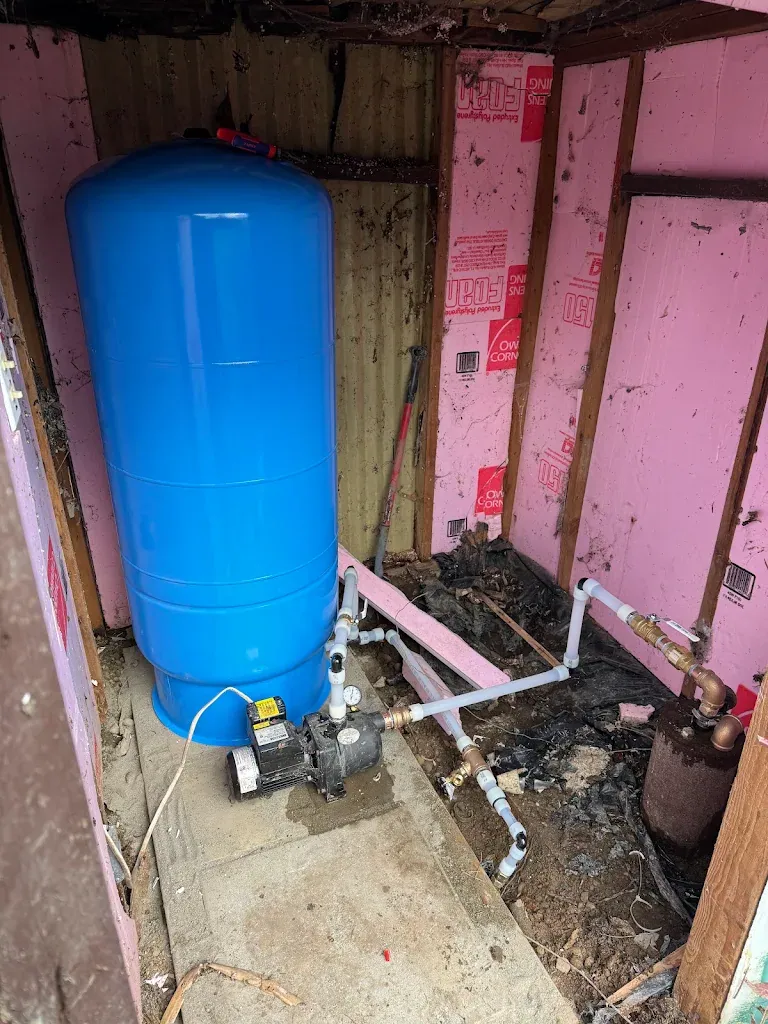
Inside the house, a well house, or a crawlspace, the line reaches the pressure tank. The tank has a rubber bladder or diaphragm with compressed air on one side and water on the other. The air cushion stores water under pressure so a faucet gets flow without the pump starting every time, and it lets the pump run in reasonable cycles rather than flicking on and off. Well-X-Trol and Amtrol are the tanks we install most.
A pressure switch next to the tank reads line pressure and closes a contact to start the pump at the cut-in pressure and opens it at the cut-out, commonly 40 and 60 psi. A pressure gauge, a check valve, a drain, and a shutoff round out the tank tee. From there the water may go through a sediment filter, an iron filter, a softener, or a UV light before heading to the house plumbing.
What Kitsap Public Health District asks of well owners
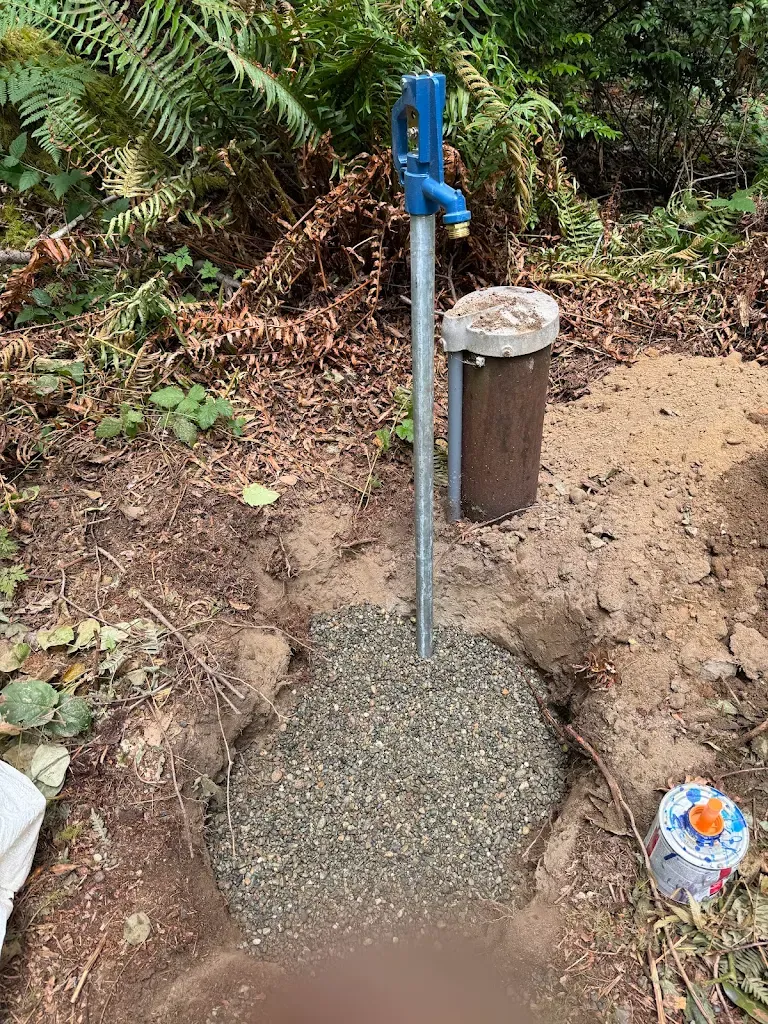
The district regulates private and small group wells in the county and keeps its guidance simple. It recommends that private well owners test for bacteria annually and for nitrate every three years, sending samples to an accredited lab. It wants the wellhead kept above grade, at least six inches, and accessible, with the cap and casing sealed, because openings there let surface water and contamination straight into the well.
Since 2019, a Water Status Report from the Health District has been required before a property served by a private well or a Group B system can be sold. The district recommends applying about 30 days before closing so any problems can be fixed first, and it reports that in 2025 close to half of the private well reports it issued identified significant problems. A loose cap, a wellhead in a pit, or missing records are typical findings.
Group B systems, which serve three to fourteen connections and are common on shared-well parcels in rural Kitsap, need a current operating permit, user agreements, and their own sampling schedule. If you share a well with neighbors, find out who holds the permit before a problem arises. Mason County Public Health has its own well program; contact them for properties in Belfair, Allyn, Shelton and the Hood Canal communities.
Water quality in local wells
The water in Puget Sound aquifers is generally low in hardness compared to most of the country. What it does carry, depending on which layer the well draws from, is dissolved iron and manganese. A U.S. Geological Survey study of groundwater in central Kitsap County found manganese above the secondary drinking water standard in a majority of the wells sampled and iron above its standard in a good number, with the exceedances tied to low-oxygen conditions in certain aquifer layers. Those are aesthetic standards, not health limits, but they stain fixtures and laundry orange or black and give water a metallic taste.
Hydrogen sulfide, the rotten-egg smell, is the next most common complaint, especially in deeper wells and in hot water. Sulfur bacteria in the well or in the water heater produce it. Some wells also run acidic, with low pH that corrodes copper and leaves blue-green stains. Nitrate shows up occasionally near older septic systems and farmland, which is why the district wants it tested.
Arsenic occurs naturally in some Puget Sound aquifers and does not announce itself by taste or color; if you have never had your well tested for it, that is worth adding to the next lab order. A full panel once, then bacteria yearly and nitrate every three years, gives you a complete picture.
Maintenance a well owner can do
A private well mostly runs itself, but a few habits catch problems early. These are the ones we tell every new well owner.
- Walk to the wellhead each season: cap tight, casing above grade, no standing water, no rodent or insect entry, no sprinkler spraying on it
- Note the pressure gauge reading when a faucet is running and when the pump has shut off; a changing pattern is the first sign of tank or switch trouble
- Listen for the pump cycling: a pump that starts and stops every few seconds while a faucet runs means the tank has lost its air charge
- Replace sediment filter cartridges on schedule and watch how fast they load up
- Keep records: well log, pump replacement date, tank date, test results
- Send a bacteria sample to a lab every year, and a nitrate sample every three
What a plumber does, what a pump company does, and what a well driller does
We handle the well house and everything plumbed on the house side of it: setting new pressure tanks and switches, replacing gauges and check valves, rebuilding the tank tee and manifold, repairing the line from the well house to the home, insulating and heating the building, fixing a frozen or broken yard hydrant, and installing treatment after the tank. Most of that is a half-day job with parts we carry.
A well pump company handles the pump: pulling it from the casing, replacing the submersible or jet pump, the drop pipe, the pitless adapter and the control box. That work takes a hoist and well-specific gear, and we do not do it. When our tests at the well house point to the pump, we tell you so and refer you to a pump outfit, and we are glad to coordinate so the tank and switch side is ready when they set the new pump.
A licensed well driller handles the well itself: drilling new wells, deepening or hydrofracturing a well that has lost yield, repairing casing, and the decommissioning the state requires when a well is abandoned. If your problem is that the well has run dry in late summer, that is a driller conversation; if the tank is waterlogged, the switch is burned or the well house froze, that is ours.
Freezes, outages and the rural wrinkle
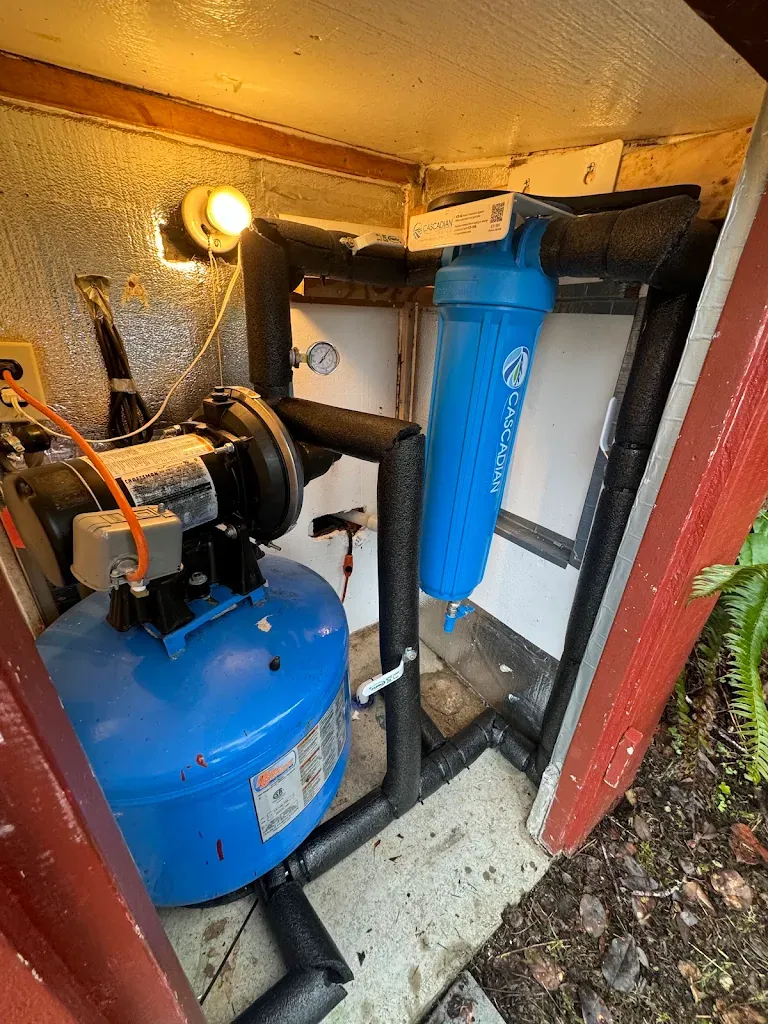
A well house or an exposed pressure tank is the first thing to freeze when an arctic blast comes through, as many Mason County owners learned in December 2022 and January 2024. Insulating the well house, keeping a small heat source in it, and wrapping exposed pipe near the tank go a long way. A tank tee that splits in a freeze floods a crawlspace fast.
Power outages stop the pump, and Peninsula Light and Mason PUD customers in the wooded parts of the county lose power more often than city residents. A generator with a circuit for the well pump, or at minimum a few days of stored water, is sensible on a rural property. When the power comes back and the pump has been dry, let it refill the tank and run a faucet to clear air before judging the system.
Septic and well share the same yard, and the state sets minimum separation distances between a wellhead and a drainfield. If you are adding a drainfield, a shop, or a structure near the well, the county will want to see those distances honored. Keeping the well upslope and away from where wastewater goes is the single best protection a rural homeowner has.
Frequently asked
How often should I test my well water in Kitsap County?
Kitsap Public Health District recommends a bacteria test every year and a nitrate test every three years, using an accredited lab. A one-time full panel including iron, manganese, pH, hardness and arsenic tells you what treatment, if any, the water needs.
Why does my well water stain everything orange or black?
Dissolved iron stains orange and manganese stains black or brown, and both are common in Kitsap and Mason County aquifers. An iron and manganese filter, sized to a water test, removes them. A softener alone handles only low levels.
Do I need a Water Status Report to sell my house?
In Kitsap County, yes, for any property on a private well or Group B system. The Health District issues it, and recommends applying about 30 days before transfer. Mason County has its own program; check with Mason County Public Health.
How long does a submersible well pump last?
Many run 15 to 25 years. Sandy wells, frequent short cycling from a bad tank, and running dry shorten that. A waterlogged pressure tank is the most common thing we find killing pumps early, and the tank is the part we can fix before the pump company has to be called.
Can you fix low pressure on a well?
Usually. The fix depends on the cause: a pressure switch set low, a tank with no air charge, a clogged sediment filter, or a long run from the well house to a house uphill, which sometimes calls for a booster pump after the tank. If the cause turns out to be a worn pump, we tell you and refer you to a well pump company.
Who do I call if my well runs dry?
A licensed well driller, who can assess yield and deepen or rehabilitate the well. If the pump itself has failed and the well still has water, a well pump company replaces it. If the tank, switch or well house plumbing is the problem, call us, and if you are not sure which it is, we can check the system at the well house and tell you.
About the author. Gregory Lowe is the owner and lead plumber at Washington Plumbing & Drain, a veteran-owned company in Port Orchard serving Kitsap, Pierce and Mason counties. The guidance here comes from daily work in local homes, not from a content farm. Call (360) 812-1124 with questions.